Thursday, February 28, 2019

Cinema Spotlight: "I hear everything" in Superman Returns


This is a new series I’ll do from time to time, highlighting certain great moments in cinema. Maybe it’s a great piece in a great movie, maybe it’s the one highlight from a bad movie, maybe it’s something else. Here, I start with one of my favorite subjects: superheroes. Let’s get into it!

The moment: “I hear everything” in Superman Returns

Superman Returns is not a particularly good movie. It has a lot of issues, but there’s also some great stuff there (including Superman being shot in the eye and we watch as the bullet crumples, another great throwaway moment). The real issue with Superman has always been a problem of conflict. How can there be conflict with this character? Who provides a real conflict for this God of a being? And from a narrative perspective, what is Superman’s motivation? What keeps him from his desires?

Superman is the most overpowered of all widely known superheroes (flight, super strength, super speed, laser vision, X-ray vision, cold breath, seeming indestructibility, etc.) and his only weakness being kryptonite has always felt stupid to me. Not because he shouldn’t have a weakness, but because he should, and a stupid piece of green rock that always ends up in the hands of the bad guys to help immobilize Superman just long enough for the plot to continue has always felt like a lame contrivance for such a character. Superman Returns fixed that issue, even if I’m not sure it realized it did.

In the scene I want to talk about, Superman (Brandon Routh, who was a decent Superman and deserved more than he was given for his work) takes Lois Lane (Kate Bosworth, a little bland, feels too young and maybe miscast) up into the stratosphere, looking down on Earth, and they have this short exchange:

Superman: “What do you hear?”
Lois: “Nothing.”
Superman: “I hear everything." (pause) "You wrote that the world doesn’t need a savior, but every day I hear people crying for one.”

And this was revelatory to me because it finally gave Superman internal conflict. He wants to save everyone, but can’t because even though he’s got a godlike amount of powers, he’s not a true omnipresent god. He literally can’t save everyone. He must worry about even being able to save those he cares about. What about the people he can’t save? Those people are still on his conscience. He still hears their cries for help, even as he can’t help them. How do you live a life with that kind of stuff taking up your headspace? How is he supposed to have a nice quiet dinner with Lois while he can hear people all over the world crying for help, being hurt, killed, raped, etc.? Obviously he has to develop selective hearing, which must also lay heavy on his conscience knowing that he’s tuning out people who could use his help.

Now, Superman Returns doesn’t do anything with this newfound depth. The plot is still concerned with bullshit about Lex Luther creating new real estate or something, but this moment completely upended my feelings about Superman as a character. He wasn’t boring anymore and it’s something I still think about even when reading comics or watching subsequent Superman movies. Even though those movies don’t earn it, this depth is still there for me. And that's all thanks to this moment.

Wednesday, January 30, 2019

Dogfight

Sometimes actors are gone from us too soon. We see it all over Hollywood history in everyone from James Dean to Heath Ledger. In one of the most famous cases, River Phoenix died in 1993 at only 23 years old. Always flush with talent, he gave us a few great performances in his short time: Stand by Me, his Oscar nominated turn in Running on Empty, and what many point to as his best role, in 1991’s My Own Private Idaho. But it’s his other 1991 role that has always been a favorite of mine, as young Marine Eddie Birdlace opposite the perpetually underrated Lili Taylor in Nancy Savoca’s Dogfight. I first saw this movie as a teenager, it came on one of the movie channels, and I was uncharacteristically sucked into it. It was vulnerable, quieter, and so much deeper than other romance movies I’d been exposed to. It has stuck in my mind ever since, and I was happy to revisit it recently.

Set in 1963, just before the Kennedy assassination, Dogfight is the story of a group of four Marines set to ship off to Korea and then “a little country called Vietnam.” They decide to use their last night to hold a dogfight, a particularly cruel contest where they each pitch in some money, bring a date to a bar and the guy who brings the ugliest girl wins. Phoenix’s Eddie looks around town for a girl but eventually starts running out of time and charms coffeehouse waitress and aspiring poet Rose (Lili Taylor) into going with him. Rose is not ugly but plain, awkward, and shy. It’s actually she who feels sorry for him and agrees to go on the date. Eddie then begins having second thoughts just outside the bar, as Rose is a sweet, interesting girl. But when his buddies see him, he can’t back out and Eddie takes Rose into the bar where he proceeds to try and drink his guilt away.

Naturally, Rose will find out the true nature of the date, but the movie’s charm isn’t in standard tropes of watching these two fall in love and then the truth comes out to act as the thing to keep them apart before they finally reconcile and the music swells and credits roll. We’ve seen that from lesser movies over and over again. No, we get that stuff much earlier in this movie, and the real magic comes after Eddie convinces Rose to let him take her to dinner to make up for bringing her to the dogfight.

Rose’s decision to go back out with Eddie is occasionally a point of contention with some viewers. How, after being subjected to something so cruel, could Rose then trust Eddie enough to go out with him again? In the powerful scenes where Rose confronts Eddie, and then Eddie convinces Rose to go out again that night, we see that Rose isn’t a pushover. She isn’t “going along with it” the way that society at the time may have expected her to. Her kindness isn’t weakness. She has great amounts of empathy, sweetness, and anger. Eddie gets to see all of these sides of her. But I think she agrees to go out with him again because she can see that he is different than his Marine buddies. He isn’t the callous asshole that they are; he’s just been trying to conform. Rose is sensitive and perceptive enough to see the inner him that he is trying to not let out.

The dinner scene is one of my favorites, as we see Rose put Eddie in his place with his overuse of cursing and his childish beef with the snooty maitre d’ at the restaurant. And she is not mothering him into acting right so much as she’s letting him know that his immature shit won’t fly with her. He shapes up accordingly and we see the vulnerability and sweetness come out from underneath Eddie’s facade. Then the two begin to connect for real, and we are in for one of my favorite romance movies.

Dogfight is one of those quiet little movies that doesn’t shine because it has the greatest script or flashy cinematography or something (though those are both terrific). We are greatly aided by wonderfully subtle direction and command of tone from director Nancy Savoca, but this movie soars because of the casting of River Phoenix and Lili Taylor. Phoenix has always been a revered actor, even during his life, for his ability to project toughness and sensitivity within a character, sometimes simultaneously. He was truly one of the great talents that we lost at too young an age. This is my favorite of his performances.

Lili Taylor came to mind after revisiting High Fidelity last month. In that she plays one of John Cusack’s top 5 loves of his life. There she’s too needy and beaten down by life for Cusack to hash out why their relationship failed. But here, a young 24, she is so engaging, funny, sweet, strong, and believably kind that we fall in love with her right alongside Eddie. Taylor has always been good, and she has worked endlessly, but she has never been better than she was in Dogfight. Both of these people are among the greatest romantic characters in cinema. This is one of those movies that make you mad at other movies for being so basic and uninteresting.

The ending doesn’t work for some people, but I loved it. Roger Ebert said you have to be a little bit idealistic for this movie to work, but I think you just have to have an empathetic and open heart. Many of River Phoenix’s roles have become sort of mythical since his early death (as always happens when an artist dies too young), but for some reason Dogfight has continued to be a Hidden Gem in his filmography. It deserves more love. It’s one of the screens great romances, showcasing actors at the top of their game.

Tuesday, January 29, 2019

High Fidelity


High Fidelity is one of my very favorite movies, but it didn’t start out that way. As a 17 year old leaving the theater, I loved Jack Black’s over the top blowhard sidekick, Barry, but honestly John Cusack’s lead character, and his journey through revisiting the loves of his life and how the relationships failed, just kind of left me wanting more. I thought the movie was good, but not great. Self-reflection and development didn’t mean a whole lot to a 17 year old, who woulda thunk it, right? As I revisited the movie over the years, though, as all great art does, it grew inside my mind and heart. I cared more, I understood more, I connected more. By the time I was in my late 20’s, with some life under my belt, it became a very personal favorite movie of mine.

We are plopped right into the action as Rob (Cusack) is in the middle of a breakup with his girlfriend Laura (Danish actress Iben Hjejle being perfectly American). To try and get under Laura’s skin, Rob shouts at her that she’s not even one of the top 5 real loves of his life, she didn’t mean that much to him. She couldn’t really hurt him because she wasn’t one of these special top 5 that had his heart. They were the ones that really hurt, not her. We soon learn that Rob is just lashing out in anger, but we maybe learn it faster than Rob does as he counts down the top 5, because things keep coming back to Laura.

Rob recounts these stories directly to us in a tricky little bit of filmmaking where he breaks the fourth wall and talks to us directly the way Rob does in the book, the way that filmmakers rarely do in the movies, and even more rarely do well. This is about as good as it’s ever been done. We go inside Rob’s head, inside his thoughts and emotions and self-doubt and narcissism. We even see his fantasy of revisiting the top 5 girls, talking to them in person, and it feeling like a Bruce Springsteen song, complete with a Springsteen cameo talking to Rob as Rob talks to us. And when Rob eventually has his emotional breakdown and begins truly learning his role in his own life, his part in all the failed relationships, he has those moments *to* us, directly to camera.

Written by the team of John Cusack (who also produced in addition to starring), Steve Pink, Scott Rosenberg, and D.V. DeVincentis, the script is tremendous. Usually four listed writers on a movie is a bad sign, that you’re going to get something scattershot and without a clear vision because it’s gone through too many writers hands and isn’t going to congeal into a true whole. Not here. Tasked with adapting Nick Hornby’s brilliant 1995 book of the same name, moving the action from Hornby’s London to Cusack’s home town of Chicago, the writers created a story with meaning, heart, humor, and emotion. Creating people sharply drawn in their desires and their faults.

And behind the director’s chair is the steady hand of Stephen Frears, twice Oscar nominated as Best Director (for the Helen Mirren starring The Queen as well as 1990’s The Grifters, a brilliant little neo-noir also starring Cusack), he wasn’t even nominated for his most iconic movie, the 1988 adaptation of Dangerous Liaisons. Here I have to assume that some of that elusive cohesion of the story has to have come from Frears. This movies tone is pitched at absolutely the perfect note. Not just any filmmaker could’ve gotten it so right and seemed so effortless.

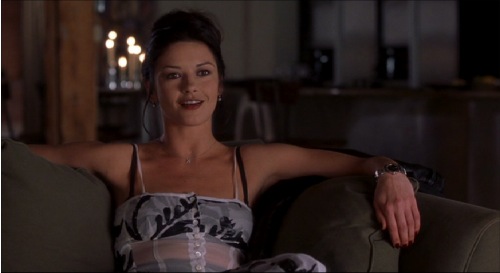
We follow Rob not just through his past relationships (the most memorable with Catherine Zeta-Jones’s Charlie), but also through Laura’s fling with a neighbor (Tim Robbins), Laura’s friend Liz (Joan Cusack) and her job as the go between for Rob and Laura during the breakup, and Rob’s day to day life as the owner of a record store alongside his employees Dick (Todd Louiso) and Barry (Jack Black). We also meet a sexy local singer/songwriter the guys all have a crush on, played perfectly by Lisa Bonet. The guys obsessively make top 5 lists, such as Top 5 opening tracks on an album, Top 5 songs about death, and sometimes super specific but abstract lists like Top 5 songs to play on a Monday morning. These scenes are what Jack Black owes his career to, as he is electric and steals every scene he’s in. It was obvious what a talent he was immediately upon seeing this movie.

I loved this aspect of the movie most upon initial viewing, because I was a list obsessed teenager myself. These guys were in their 30’s, but I still saw myself (which shows you how much room they have to grow). Things changed for me later just as they do for Rob. I experienced more, I developed and grew as a person just as Rob grows over the course of the movie. In the beginning Rob is so obsessed with music, songs, albums, and making lists that he ignores the important things in his life, like his relationships and how he is the one sabotaging himself more than he is a victim of the behavior of others. He even says that he, Dick, and Barry have talked about how the most important thing about a girl is what she likes, not what she is like. But eventually he even starts trying to figure some things out, like what he wants to do with the rest of his life, and who he wants to be as a person. The kind of things that we all need to figure out.

For as good as the writing is, and the supporting cast is, this is the only movie that has really, truly captured what John Cusack can do as an actor. He’s been the jaded cool guy, the rom-com lead, the detective or cop, the comedic leading man, and much more, but in High Fidelity he got the best role of his career and he embodied it more than ever with the vulnerability, intelligence, and humor that has always been there but never coalesced into such a tremendous performance. Rob Gordon has become a milestone character for me as a moviegoer. Maybe the character I most resemble and relate to.

Rob is the best rom-com lead character (because at its core this is really a rom-com for guys), he takes us more intimately into his brain and his being than almost any other character has. We *know* Rob by the end of the movie. And if you can go on the journey with him and not be turned off by some of his early (more self-obsessed or arrogant) behavior, we love Rob by the end. Watching him grow out of his state of arrested adolescence is cathartic, hilarious, and heartwarming. It’s the best work from one of our most underappreciated actors, and even if many people know of the movie, more people should see it. And expect it to grow in your mind the way it did mine. It’s a real Hidden Gem.

Wednesday, December 19, 2018

Top 10 Romance Movies

The romance, one of the great genres of cinema. Often thought to be just "chick flicks" or rom-coms, I find that romances can have as much to say about life and act as mirrors to ourselves as any other genre. Our romantic relationships are often the most important thing in our lives, so why shouldn't we take a more thoughtful look at romance as a serious genre? It shouldn't be something to be dismissed or taken lightly, though I'll be honest and say that I love a good rom-com too. Not because they're romantic necessarily, but because enjoyable light fluff is nice sometimes. And sometimes a Meg Ryan infusion can be good for your life. None of those movies show up here, but don't think it's because they weren't in consideration. Now, onto the list!

Honorable Mention for:

Three Times

I almost put Three Times on the list, but it would've really only been for the first section, which is simple and sweet and wonderfully romantic. The other two sections explore love and romance, but aren't really romantic, so I ended up cutting this movie from the list.

5 Centimeters per Second

A beautiful story of appreciating love's place in our growth as a person, and loving the part that plays in our hearts. It has a romantic heart, and would've made it onto this list if not for the ridiculously stiff competition.

Out of Sight
One of the great crime movies, but with a terrific romance driving it, something about making a list of "romance movies" kept me from putting Out of Sight on this list, despite liking it more than most of the movies on the list as a whole. I don't know, this is one of those weird instances when making genre lists that although something may technically qualify as a certain genre, I don't include it because it doesn't feel like a "romance movie" as much as it is a movie with a romance in it, if that makes sense.

10. Sing Street

John Carney’s Sing Street was one of the most unfairly overlooked movies of 2016. It’s the coming-of-age story of Conor (Ferdia Walsh-Peelo), a teenager in 1985 Dublin, Ireland. His family is falling apart, his parents constantly fight, economic times are tough, he’s being transferred to a new Catholic school full of bullies and harsh administration, and (as we all do at that age) he’s trying to figure out who he is as a person. Conor plays a bit of guitar and writes a bit of poetry, but he doesn’t really know who he is yet. What 15-year-old does? Into the mix, as usually happens in these stories, steps “the girl,” Raphina. Conor asks her to be in his band’s next video, to which she agrees. He then promptly walks away and up to Darren, the only friend he’s made at his new school, and says “We need to form a band.”

Conor ends up finding himself through the band and through music. It all started because he wanted to impress a pretty girl, but it took hold of him and became a much deeper experience than that eventually. And Raphina isn’t just a pretty face, and she isn’t a manic-pixie-dream-girl there only to spur Conor’s character development. Raphina is a fully well rounded character, played in a beautifully heart felt and vulnerable performance by Lucy Boynton. She has her own arc, her own insecurities and strengths and weaknesses. And Conor loves her through all of it. What begins as shallow infatuation with the pretty girl deepens as Conor becomes more himself and grows through his music. I’m not sure if this performance is the beginning of a career for Ferdia Walsh-Peelo, since he is a musician first, but it’s one of the great coming-of-age lead characters.

9. Groundhog Day


"I was in the Virgin Islands once. I met a girl. We ate lobster and drank pina coladas. At sunset we made love like sea otters. That was a pretty good day. Why couldn't I get that day over and over and over..."

Groundhog Day is a modern comedy classic, but one that I don't think gets enough credit for the things it does that no other movie does. What other studio comedy cares about the loneliness of its main character, doomed to repeat February 2nd for God knows how many years (writer Danny Rubin has said he envisioned Bill Murray's Phil repeating the day for about 10,000 years)? There's a sad, lonely heart at the center of this movie. But ultimately when Phil decides to be a better person, to help save people, do good things because it feels good, and try to win the heart of his producer Rita not just so he can sleep with her, but because he's come to see that she's the type of person he wants to be, she's innately good, every time he lives this day. He falls in love with her consciously or unconsciously he determines to make himself worthy of her.

Some people have had problems with this relationship over the years, as Phil has knowledge that Rita doesn't, and uses it to seduce her. But I don't share that this is even what happens. When Phil tries to seduce Rita the way he's seduced other women in this repetitious world, she rejects him. It's only through what I imagine are years of making himself change, internally, every day, that she is able to see him for who he is, even if it's just the next day to her. She isn't experiencing time the way that he is, but she senses the changed man inside from the previous man she knew. She isn't a victim of Phil's seduction. She's the object spurring him into being the best version of himself, and loves him for being that.

8. Annie Hall

Roger Ebert said that Annie Hall is "Just about everyone's favorite Woody Allen movie", and I guess that makes me like everyone because it is certainly my favorite. Turning a corner from his earlier farces (with which he'd had great success), Annie Hall adds a lot of depth and weight to Allen's still hilarious humor, making for THE romantic comedy of all time, even if it's too singular to Allen to be copied to death like rom-coms tend to be.

Miraculously winning Oscars for Best Picture, Director, Screenplay, and Actress (miraculous because this was the year of Star Wars, after all), I think Woody and the gang deserved it. It's hilarious from start to finish, whether Woody is evoking Groucho Marx ("I'd never be a member of a club who'd have someone like me as a member"), fearing for his life as Annie's crazy brother (played by an insanely young Christopher Walken) might kill them, or breaking the fourth wall and giving us in the audience little asides from the plot. My favorite is actually one with a hint of melancholy, where Alvy (Allen's character) tries to recreate different crazy antics he'd had with Annie with a new girl after he and Annie broke up, only to have the new girl not join in and he realizes just how special Annie was. That's what I remember from this movie, that sense of appreciating the time you've had with someone, even if you didn't end up together.

7. Adventureland

Movies like Adventureland are rare. They see their characters lovingly without idealizing them. They see a place and time so truly that we forget we are watching a period piece. They remember what it felt like to be young and in love. Remembering the friends you wished would go away when you were trying to talk to a girl, the awkward silences you’d endure before you figured out how to really talk to women, the feeling of what it's like to be accepted by the one person you hoped would accept you, and the myriad of memorable people that may only come into your life during the course of one crazy summer. Adventureland is the most wonderfully realized, delicately crafted, and emotionally affecting movie about young people that I've ever seen. It captures a moment in time that didn't even exist in my life, yet I connect to it so deeply I almost can't explain it.

There's not a single moment in the movie that rings false to me, and so many moments that transcend the maligned "young adult/teen" genre. Of course, this movie is not about "teens," it's about people just out of college realizing that their studies in Comparative Literature or Russian and Slavic Languages don't mean much in the real world. It's also about those fragile feelings of first love, real friendship, jealousy, and taking the wrong advice because you don't know any better yet. More than anything really, it's the story of first love. But because everything is so carefully constructed, capturing life, the feeling of real life, it's about much more than that simple description might allude to. Sure, it's not documentary-esque real life, it's idealized and nostalgic, but in the best way possible. And that's typically what the story of our own first love feels like to us. We've nostalgized it, even if we do remember some of our old awkwardness, we still tend to remember the past with rose colored glasses, and I think Adventureland evokes this beautifully.

6. The Princess Bride

The story of fairy tale love had to be here somewhere, so why not in one of the great fairy tales? I've written about this movie recently on my Live Action Fantasy movies list, so I won't drone on about it again except to say that the comically romantic fairy tale romance at the center is something I didn't appreciate as a younger person. Even now, Cary Elwes and Robin Wright are almost too pretty, too perfect, too charming. But somehow it works even as it's almost parodying fairy tale romances, it becomes a wonderful example of one. Much like the movie as a whole.

5. High Fidelity

High Fidelity is a movie that didn't immediately make an impact on me. As a 17-year-old, I walked away from the theater loving Jack Black's hilariously over-the-top know it all Barry, but not really connecting with John Cusack's self-loathing (yet occasionally arrogant) Rob, and his travails through the top 5 loves of his life, and why they didn't work out. A few years later, I watched the movie again and found it deeply affected me on an emotional level, now that I had some life experience with what Rob was talking about, and a deeper love of the pop-culture that Rob also cherishes. Now, as a 35-year-old with even more experiences, I find more than ever that I connect not just with Rob, but with Barry, Dick, Liz, and Laura. All the characters are amazingly well drawn (much of which comes from Nick Hornby's brilliant novel) and brilliantly played by the actors, with even Jack Black seeming like a real character, and not just Jack Black.

One of the things that I think works so wonderfully here is watching Cusack's Rob grow from a self-involved juvenile at the beginning of the movie, hurt by his girlfriend Laura leaving him for another man, to realizing how he failed as a boyfriend, how he's failed as a grown up, and how he can grow. Too often we just stay in that first period in our lives. We stay hurt, we let ourselves feel like victims of other people because it can be painful to think that we may have been the reason for the bad things that happened in our lives. And when Rob finally counts down the top 5 things he misses about Laura, we know that he's starting to take responsibility for his failings, and to learn from them to make a better life. We should all hope to do that.

4. Casablanca

A movie it took me a while to come around to, I only watched Casablanca for the first time maybe 10 years after I'd become a movie buff. And I don't think I can find a flaw in the world's most famous B-movie. Not intended as one of the big studio productions, Casablanca simply came together in the happiest of accidents and became one of the most beloved movies ever made. It took me a long time to see it, but as soon as it was over I wasn't asking myself what the big deal was, I was kicking myself for waiting so damn long to see one of the greatest movies ever made and the best movie of the 1940's.

I have to detail my personal favorite scene in the movie and the reason why Humphrey Bogart was one of our greatest stars. After seeing Ilsa again, and hearing "As Time Goes By" for the first time in years, Rick sits drinking alone after closing the bar. Sam comes in and starts playing piano, Rick gives his "of all the gin joints in the world, she walks into mine" speech, but then asks Sam what he's playing. Sam says it's something of his own, and Rick lashes out at him to "stop it! You know what I wanna hear. If she can stand to hear it, I can!" and the look of complete devastation on Bogie's face should've won him an Oscar. The only reason that Casablanca isn't higher on the list is that there isn't much actual romance in it. It's about love lost, self sacrifice, and other things, but the active romance in the movie is between "the girl" and her new guy, rather than our hero. That's what helps make the movie work, we can feel the love between Rick and Ilsa, even if the time has passed for their romance. But still, it didn't feel right to have it top this list, even if it is my favorite movie on this list.

3. Eternal Sunshine of the Spotless Mind

The crowning achievement in Charlie Kaufman's catalog is the 2004 comic romance Eternal Sunshine of the Spotless Mind, which teamed him again with French music video director Michel Gondry (who had previously directed Kaufman's script Human Nature, still unseen by me). It concerns the relationship of Joel and Clementine, characters extraordinarily brought to life by Jim Carrey and Kate Winslet. Kaufman started from the idea of erasing someone from your memory (who hasn't wanted to do that before?) and the impact that memories have on us as people. The way a loved one can get so associated with something that to remove it would be to remove a part of your own being. The impulsive Clem has had Joel erased from her memory by a company called Lacuna that provides such a service. As a way of getting back at her, Joel decides to erase her from his memory. Joel at one point asks Dr. Mierzwiak (the always brilliant Tom Wilkinson) if there's any chance of brain damage caused by the erasing. He answers "Well, technically speaking, the procedure is brain damage." There's an achingly sad moment when you realize that Joel doesn't remember the song "My Darling Clementine", even though it had deep meaning to him long before meeting Clem. It had become so associated with her in his mind that to remove her removes all traces of the song as well as his childhood favorite, Huckleberry Hound. For the majority of the movie we travel with Joel through the good and bad memories of the two years he spent with Clem. It's hysterical, heartbreaking, amazingly true to life while being totally surreal. The brilliant score by Jon Brion is worth mentioning. It plays more like an accompaniment to the action onscreen, instead of trying to underline it, or try and inform the audience how to react emotionally.

2. Notorious

An underappreciated masterpiece, Notorious features Cary Grant, Ingrid Bergman, and Claude Rains all in top form. Bergman plays Alicia Huberman, the daughter of a convicted Nazi spy who is recruited by U.S. government agent Devlin (Grant) to turn spy against a group of German’s working out of Rio de Janeiro just after WWII. Devlin convinces Alicia to infiltrate the group through one of her father’s former friends Alexander Sebastian (Rains), whom he wants her to seduce. It becomes a harder mission after Devlin falls in love with Alicia, and she with him. Sebastian is also in love with Alicia, which makes it even harder on our two lovers, because Alicia did her job so well. Oh yeah, and there’s some bit about Sebastian enriching uranium for nuclear weapons.

This basic plot was stolen by Robert Towne in his screenplay for Mission Impossible 2, but it was done with far less success. Cary Grant gives his greatest performance as Devlin, who is emotionally eaten up by forcing the love of his life into another mans arms. Bergman is as good as she ever was as the woman being pushed away, and Claude Rains was deservedly nominated for an Oscar for his role. Notorious also features one of Hitchcock's endings, as Devlin steps up to save the woman he loves, making for Hitch's most romantic movie as well.

1. Before Sunrise/Sunset

Before Sunrise is where we see young American Jesse, riding the train through Europe when a German couple begin arguing and he finds himself watching them, while also catching the eye of a pretty blond girl trying to read her book. After the arguing couple leave the car, Jesse strikes up a conversation with the girl, Celine, who is on her way home to Paris. Just as the conversation is starting though, the train arrives at Jesse’s stop in Vienna. He convinces Celine to get off the train with him and wander the city all night before he has to leave home for New York in the morning. So they walk through the city, talking, philosophizing about nearly everything under the sun. Jesse pretends to be more coolly jaded than he is, trying to hide the hopeless romantic underneath. Celine is outwardly, initially, quirky and fun and lighthearted, but soon comes out that she is opinionated, her intelligence razor sharp, though she too has the heart of a romantic. They connect deeply, and it’s exhilarating to see them fall slowly in love over the course of the night that changes both of their lives. In the morning they agree that it’s crazy to give up their lives for each other, even though they’re obviously head over heels for one another, because they just met. So they agree to meet back in Vienna in six months, and if they show up, they know that what they had was real. They part and we watch as they smile to themselves as they bask in the glow of that glorious night.

After the open-ended beauty of the ending of Before Sunrise, when I heard they were making a sequel, I was angry, as the ambiguity of the ending to the first movie would be ruined by catching up to the characters again. Part of the genius of it is that you got to make up your own mind about whether you thought the characters got back together in six months.

At the beginning of Before Sunset (my favorite of the trilogy, if I had to pick) we see Jesse having this exact conversation with a group of journalists in a bookshop in Paris. We realize that he’s written a book about that night, “fictionalized” it, and he’s telling the reporters that the ending of the book is meant to be made up by you. If you’re a romantic, you think of course they got together. If you’re a rationalist, you hope they did, but it’s understandable that they probably didn’t. If you’re cynical, you think there’s no way they made such a big leap for a person they’d only known for 10 hours or so. I was the romantic that wanted them to have gotten back together. Of course, I first saw the movie when I was about their age, early 20’s, idealistic and in love with the idea of being in love. But we don’t see Celine around. What happened? We soon find out as Celine shows up to the bookstore and the movie goes on a real time journey of 90 minutes before Jesse again has to catch a plane back to New York.

I didn't include the third part in the trilogy, 2013's Before Midnight, because I don't find it romantic. It's an important entry into the lives of these characters, but since it deals mostly with their middle aged malaise and crises of choices in their life. It's a good movie, real, often uncomfortably so, but it's not the romance that the first two entries are.

Wednesday, December 12, 2018

Top 10 Courtroom Movies

One of the most time honored genres in all of cinema is the courtroom movie. Typically called courtroom dramas, but some of my favorite are comedies, so I'm not sticking strictly to dramas. For as much as we tend to dislike lawyers in everyday life, we sure do love them on screen. There's something inherently dramatic about a man standing up to the system and winning, or catching the bad guy in the system of law and bringing him down. But there are tons of different angles that a law movie can take, and I hope that's highlighted here. I didn't pick these movies to be diverse, I'm just picking my favorites, but I think they turned out to show a great diversity within what could seem a confining, though beloved, genre.

Honorable Mentions: 12 Angry Men

Although often thought of as one of, if not THE, courtroom movie, 12 Angry Men just doesn't quite move me like it seems to do others. Something about the slow turning of the jurors over the course of the movie, as well as the coincidental knowledge of some of the men, just rings hollow and contrived to me. And it felt that way when first reading the play in high school, before I was aware of the movie. Sidney Lumet is one of my favorite filmmakers, but this wasn't high enough in my ratings to make it onto the list.

...And Justice for All

Not just memorable for Al Pacino's great work, but also for showing the case load that many lawyers have. Although we know they're overworked, in seemingly every other law movie, it seems the case at the center of the movie is the only case the main character has to deal with. Here we see Pacino struggle at managing his case load and sometimes the consequences are paid by his clients (in heartbreaking ways). It's a good, not great, movie, but I like that it shows this aspect of the life of an attorney in a way that seemingly no other movies show.

Michael Clayton

I also want to shine a spotlight on movies like Michael Clayton that aren't directly "courtroom movies" but are tangentially related to uncovering the truth surrounding a legal case. I initially had Michael Clayton on the list, but then realized it doesn't have many (any?) significant moments actually in a courtroom.

Now, onto the list:

10. The Insider

Michael Mann's biopic of the take down of big tobacco in the courts contains some of the best performances in the careers of Al Pacino, Russell Crowe, and Christopher Plummer. And as always in a Mann movie, the cast is perfect from top to bottom, there's great work from character actors like Bruce McGill, Diane Venora, Philip Baker Hall, Stephen Tobolowsky, and many others. And Mann really digs into some of the minutiae of the law system that held up prosecuting big tobacco for so long, as the companies tried to hold former employees to the non-disclosure agreements they'd previously signed, even as they were now no longer employees. It's a fascinating movie, one of Mann's best, and a great look at the intersection between big legal cases, media, and public health.

9. The People vs. Larry Flynt

Woody Harrelson is one of our most underrated actors, and The People vs. Larry Flynt is his best work on screen. Playing relentless rebel Larry Flynt, Harrelson is funny, charming, repulsive, tragic, and infinitely watchable. He leads us through the (literal) trials and tribulations the Hustler Magazine founder went up against in his life and makes every bit of it entertaining. Aided in the movie by supporting work from Edward Norton and a surprisingly amazing performance from Courtney Love, this is also one of the best movies in the storied career of director Milos Forman (One Flew Over the Cuckoo's Nest, Amadeus). The law part of the movie is mostly concerned with what Flynt was concerned with, which is that the First Amendment right of Freedom of Speech should be applied even to things you don't want to hear. Maybe stuff that offends you. Flynt's cases set the precedent of political cartoons, commentary, and such qualifying as free speech. As Flynt says after his court victory "If they'll protect a scumbag like me, then they'll protect all of you!" Profound, ridiculous, tasteless, and funny. This is a surprisingly wonderful movie.

8. A Few Good Men

The first time the name Aaron Sorkin became known to most people was from his play that was turned into the movie A Few Good Men. As all Sorkin scripts are, this movie is filled with great monologues and dialog exchanges. The script crackles not quite with the same energy that Sorkin would bring to later works, when he had honed his craft some more, but still within the confines of a courtroom movie, Sorkin's dialog elevates this movie above its conventions. Sure, the terrific cast of actors who all do good work (with only Demi Moore seeming out of her element, although she's trying) surely helps elevate the movie also. Assured direction from Rob Reiner keeps things moving towards an inevitable conclusion. The movie feels almost preordained, but part of the joy is in watching it all play out anyway. Although not nearly as powerful as another military court movie that will show up later on the list, A Few Good Men touches on a lot of the difficulties in the military, including codes of conduct, written and unwritten rules, and not talking about things that happened even if it would save your case.

7. Rashomon

Undoubtedly the least "courtroom"-y movie on the list, Rashomon is about the inability to find objective truth. What supposedly happens is that a man and his wife are attacked by a bandit, who kills the husband and rapes the wife. Rashomon is made up of 4 versions of the story, told by the captured bandit, the wife, a woodcutter who observed the incident, and (through a psychic medium) the murdered husband himself. None of the accounts exactly match with each other, with each story coming to show the storyteller in the best light. For example, the bandit's story shows him challenged by the husband (trying to impress his wife), an intense and deadly sword fight, and then the wife being so impressed by his virulent masculinity that she gives herself to him. The other stories contradict this, but also contradict each other in various ways. We're left to try and piece together the likely truth, but the point is that true objective truth is unknowable because each and every one of us views the world through our own completely subjective prism. A pretty heady concept, and one not explored often enough in these kinds of movies, I think, as everyone is always looking for "THE TRUTH" without realizing that it is unknowable.

6. The Verdict

One of Paul Newman's best performances comes in this great Sidney Lumet movie, with a script by David Mamet. Newman was at that stage in his career, at the age of 57, where he could truly do no wrong. He never gave bad performances, but he sometimes seemed to coast on his good looks and charm. Not here. We see the lines in his face. We see the toll that life has taken on this man. I think we took Newman for granted sometimes, his abilities as an actor and not just a star, and this may be his best work. He plays a down on his luck attorney given an open and shut medical malpractice suit that takes on a life of its own. Although given the option to settle for a huge sum of money, Newman opts to go to trial against the big bad guys. Newman is an alcoholic, and the case gives him a new lease on life...kind of. He needs this case to give himself a sense of himself. Who is he at this point in his life? What has he become? What does he want to become? What can he live with himself as? The Verdict is more a story about a man's journey than it is a dive into the legal system. Lumet, Mamet, and Newman make the journey well worth our time, all giving some of their best work.

5. A Civil Action

"They'll see the truth"
"The truth? I thought we were talking about a court of law. C'mon, you've been around long enough to know that a courtroom isn't a place to look for the truth. You're lucky to find anything around here that even resembles the truth. You disagree? Since when?"
"8 kids are dead, Jerry."
"Jan, that suit fits you better than that sentimentality. That's not how you made all that money all these years, is it? You wanna know when this case stopped being about dead children? The minute you filed a complaint, the minute it entered the justice system."


Like The Insider, a great look at how the big businesses in the world can shit on the every day people and get away with it for so long. John Travolta stars as real life lawyer Jan Schlictman, who took on big chemical companies for poisoning the water in a small Massachusetts town. Travolta loses everything as he fights the big companies, his money, home, law partners, everything. And the bad thing is, spoiler alert, he loses the case too. That the EPA later took up the case and beat the companies into many millions of dollars in cleanup and restitution costs is little solace for us as the movie's credits begin to roll. Written and directed by Steve Zaillian (who also made the even greater Searching for Bobby Fischer), shot by the legendary Conrad L. Hall, it's got a tremendous cast, not just Travolta doing some of the best work of his career, but also Robert Duvall, John Lithgow, Tony Shalhoub, William H. Macy, Kathy Bates, and more. Impeccable from top to bottom, I was floored when I researched this list and found that this movie only has a 60% on RottenTomatoes. I don't know why. This movie may not strike any new ground, but it's a gorgeously filmed, wonderfully written, and perfectly acted movie. And, like The Verdict, it takes on the idea of settling vs. going to trial. Everyone wants Travolta to settle so that they can get their money. Travolta even tells one of the sick mothers that justice will come from the pockets of the big companies. These two movies show different sides of the coin of going to trial versus settling for large sums of money.

4. Paths of Glory

One that I didn't immediately think about as even being a courtroom movie is this masterpiece from Stanley Kubrick. Long time readers will know that I'm not the hugest Kubrick fan, but I do love a few of his movies (2001 and The Shining being the others). Kirk Douglas stars in this movie as a WWI French Colonel defending a group of men against a court martial for cowardice after they refused to go on a suicide mission attempting to take a German stronghold, a stupidly ordered attack only meant to show bravery by Generals angling for promotions. We see the politics and scheming behind the scenes of both the military and its system of law. Douglas does maybe the best work of his career as Colonel Dax, and his great working relationship with Kubrick on this movie was what led Douglas to bring Kubrick aboard Spartacus a few years later, where both men's controlling natures clashed. Still, what we have here is one of the great idealistic fights against the system. At once part of it, yet disgusted by it, Colonel Dax fights for what is right, even when it's a losing battle.

3. My Cousin Vinny

Joe Pesci's best work, yeah I said it, is here as the talented beginning attorney Vinny Gambini. This movie is standard courtroom stuff from beginning to end, lifted up by the energy and life the actors bring to it. Not just Pesci, although seriously Pesci is amazing in this movie with how effortlessly he carries it, but Marisa Tomei, who deservedly won an Oscar for her broad portrayal that didn't really hint at how she'd later become one of our best actresses. Also Ralph Macchio as Vinny's cousin that is on trial for a murder he didn't commit. Fred Gwynne playing my favorite judge character ever ("what is a yute?"), and a supporting cast littered with great character actors like Austin Pendleton, James Rebhorn, Bruce McGill, and Lane Smith as the prosecuting attorney. A terrific script and efficient direction, as well as a look into some of the technicalities of the law (many of which Vinny keeps unknowingly tripping over and paying the price for) really make this movie that could've been a cookie cutter comedy into something special.

2. Close-Up

Close-Up is a fascinating and brilliant look at a real life case in which a man claimed to be a famous Iranian filmmaker, impressed a family, only to have them find out that he wasn't that director and his subsequent trial for fraud. That may not sound like the most compelling movie, but writer/director Abbas Kiarostami's genius use of documentary and recreation footage (where the people played themselves, and footage of the trial is intercut with the recreation of events), helps give everything an intrigue and strange atmosphere that kept me riveted. The story concerns Hossain Sabzian, a poor print shop worker who is obsessed with the movies, and is intentionally mistaken for famed Iranian filmmaker Mohsen Makhmalbaf while on a bus one day. The woman who mistakes him, Mrs. Ahankhah, does so because he claims to be the filmmaker. But when she introduces him to her family, including her sons who also are passionate about film, the little lie takes on more weight, and Sabzian goes along with it, as this is seemingly the first time anyone has really listened to him. It makes him feel important instead of poor and worthless. He is listened to, seen, and respected. We can all sympathize with that feeling, I think.

Although he admits to taking some money from the family, that he asked for and they freely gave, he doesn't see himself as a criminal. He didn't intend to rob the family or anything, I think he was simply a little bit off in the head maybe, and lonely, and in need of the kind of attention he got from the Ahankhah's. The movie has a lot to say about the needs of humanity and how we don't often get what we emotionally need. It also says a lot about the nature of performance and what kind of performances we are all always giving, even when we're trying not to.

1. Miracle on 34th Street

My favorite holiday movie, but it wouldn't be on this list, much less this high, if I didn't think it was a great movie, period. It has everything you could want in a movie, a great script, characters, terrific actors like Natalie Wood and Maureen O'Hara, beautiful cinematography, and all that. It's a big classic studio movie, and one that I find myself affected by more and more as the years go by. A look at the struggle between logic and faith, between hope and reality, between optimism and pessimism, between believing in magic or not. One could easily see it as a retelling of the story of Jesus, with believers and non-believers, persecution, a trial, and all that. I don't see it that way, I see it as a simple tale, told simply and wonderfully. I have even always loved that the story comes about because everyone is acting in their own selfish interests. From the judge holding off on making a ruling so as to not anger potential voters to the post office workers sending the "Santy Claus letters" to the courthouse just so they'll stop taking up so much space in their building. It's a funny twist for a Christmas movie, but one that I love. That this is all wrapped around a court movie is really interesting to me, and one that feels pretty accurate to the law as well. It shows that although "courtroom movie" is a genre unto itself, you can insert pretty much any kind of movie within that framework. Drama, comedy, romance, satire, even a Christmas movie.

And Edmund Gwenn will always be Santa Claus to me.