Tuesday, July 17, 2018

The New World

The Natives watch apprehensively from the shoreline as huge ships approach from the ocean, bringing with them the English settlers. As they make first contact with each other, the Natives approach quizzically, fascinated by the English weapons and armor. The two sides get along fine for a while, and when Captain Newport (Christopher Plummer) returns to England to bring back more ships, he leaves in charge Captain John Smith (Colin Farrell). Things turn sour quickly between the settlers and the "naturals" (as the English call them), and when out on an exploratory mission, Smith is captured by a group of Indians and is about to be executed before the Chief's daughter Pocahontas (Q'Orianka Kilcher) throws herself on top of Smith and pleads for his life. The story proceeds from there with a terrific mix of legend and history, the most legendary of which is an achingly beautiful romance between Smith and Pocahontas, for which there is no historical basis. But, thankfully, we don’t mind when we’re given a beautiful and engaging love story like this.

The New World is kind of the black sheep in the filmography of director Terrence Malick, or at least is the most unfairly forgotten of the bunch. Malick is a film director unlike any other. A former Rhodes scholar who got a philosophy degree from Harvard, a subject he later taught at MIT, Malick worked as a Hollywood script doctor (someone who gets paid to do uncredited rewrites of scripts) before making his first movie at age 30 with 1973's Badlands, starring Martin Sheen and Sissy Spacek as a couple who go on a killing spree through the Midwest (like The New World, a fictional story based in facts, in that case with the Charles Starkweather murders that would later inspire Bruce Springsteen’s classic album Nebraska). It was lauded by critics as a masterpiece, and Malick followed it up with 1978's Days of Heaven, with Richard Gere, Brooke Adams, and Sam Shepard in a love triangle set against the backdrop of a poetically gorgeous Texas wheat farm. Also hailed as a masterpiece, Malick's next project was highly anticipated, but he stepped away, disappearing from the film business for 20 years before returning with 1998's WWII epic The Thin Red Line, which was hailed again as a masterpiece and garnered Malick Oscar nominations for Best Screenplay and Best Director (the movie itself was nominated for 5 other awards, including Best Picture).


He thankfully didn't wait another 20 years before giving us The New World in 2005. He’s made more movies since then, including 2011’s acclaimed Tree of Life, but I think The New World deserves more attention. The story is told with Malick's trademark narration (by both Smith and Pocahontas), and his unconventional, and some say meandering, storytelling technique.

The performance by newcomer Q'Orianka Kilcher as Pocahontas is of startling complexity and depth. She's fascinated by these new people, and wants to learn about them and their ways, as well as their language. There's a wonderful sequence where Pocahontas and John Smith teach each other their different words for lips, eyes, ears, sky, wind, etc. and both actors truly shine. Although she has continued to act, we haven't really seen Q'Orianka Kilcher since The New World, and that's a shame because she gave one of the great performances I’ve ever seen from a lead actress. Kilcher is staggering in the growth she shows on screen, starting out as a curious teenager connecting with Smith. They end up sharing their language and hearts with each other before Pocahontas grows up to marry John Rolfe (Christian Bale) and eventually become a young mother and aristocrat in England.

Colin Farrell shows here (as he has done in movies like In Bruges, Seven Psychopaths, or The Lobster) that he's a tremendous actor when given the right material. You can feel his disgust and contempt for the English when he returns from living harmoniously with the Native Americans, whom he came to love and respect and deeply admire, and Farrell does it without words. Christian Bale is quietly effective in the role of John Rolfe, but we get the sense that it was Smith and not Rolfe that was the man who really understood Pocahontas and whom she truly loved. And the Native actors, led by August Schellenberg and Wes Studi speak and move and give so much gravity and authenticity (even speaking the period appropriate, and now extinct Powhatan/Virginia Algonquian language spoken at the time) to the movie in ways that we haven’t ever really seen, in my mind. Despite being a movie of historical fiction, the attention to historical detail is astounding.

But again, Q’Orianka Kilcher is the real story here, as she was robbed of every award that didn't go to her (and no major awards did). She was only 14 at the time of filming, but that's not why her performance is incredible, she shows such a depth of characterization, such intense and confused emotions, and ultimately plays an understanding of those emotions to an extent that few actors can. It is one of the great performances, and reason enough to see this movie.

Another reason to see the movie is for the incredible cinematography of Emmanuel Lubezki (who received the film’s only Oscar nomination). Lubezki and Malick create such visual poetry in every facet of the movie, whether it be the innocent love scenes between Farrell and Kilcher, the chaos of the battles between the English and the Indians, or just simple scenes of Kilcher walking through the forest. There is not a frame of this movie that isn't absolutely gorgeous. Of course, that much is to be expected from a Malick movie. His Days of Heaven has to be in the conversation as the most beautiful movie ever made. But again, The New World doesn’t get the love it deserves. I hope to remedy that a bit.

Malick’s movies aren’t for everyone. He has his own distinct style of storytelling that many have called unfocused or rambling. He often tells his stories through the small moments; walks through the tall grass, stolen bits of memories gone by, meaningful glances and always a lot of narration, usually from multiple characters. If you can surrender yourself to his style, I think you’ll find yourself greatly rewarded by this Hidden Gem.

Shattered Glass


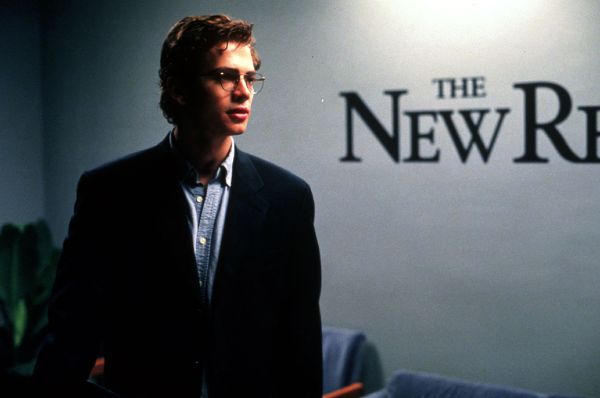
Ace screenwriter Billy Ray's 2003 directorial debut Shattered Glass is kind of a throwback to movies from the 1970s. It's driven by characters, and its drama is derived from their interactions and the slowly unveiled truth that changes the dynamics between them. It's based on the true story of Stephen Glass, a former writer for The New Republic ("the in-flight magazine of Air Force One"), who in 1998 was fired for lying in a story he wrote for the magazine. By "lying," I mean that he just completely made up everything out of thin air.

The real Stephen Glass has said that it all started by re-writing a quote from a source. He wished the guy had said a thing in this certain wording, which would’ve been better than what he actually said. So Glass took a chance and re-wrote the quote. When fact checked, the quote was okayed and Glass just kind of went from there into making up more things in his stories until he finally just fabricated them completely. Glass had made his name as the most vigorous of fact checkers when he was an intern, and so developed a reputation that when something from his story didn't quite check out, the fact checker would still okay it because Stephen wouldn't have put it in his story without thoroughly checking it first. Right?

Glass is played in the movie by Hayden Christensen, who is absolutely genius in the role, showing that George Lucas really didn't have any idea how to handle actors in the Star Wars prequel trilogy. Christensen brilliantly portrays Glass as a sort of self-conscious, wounded child that people feel a little bit sorry for, so they cut him some slack when they shouldn't. He has demanding parents he's trying to please by going to Georgetown Law School, writing full-time for The New Republic, and occasionally freelancing for other magazines as his name gets known more and more. His friendly co-workers, played by the reliably wonderful Chloe Sevigny and Melanie Lynskey, listen to his whining about being overworked, but no one really stops to think that Stephen couldn’t actually be putting in the needed amount of work to accomplish everything that he’s doing.

Glass writes a piece about hackers, a story that kills in the writers room when he pitches it, and reads the same way. Forbes Digital Tool, the fledgling online publication from Forbes magazine, picks up the story when their editors read it and are astounded that their own writers weren’t in on this thing. They've never heard of any of the details mentioned in the Glass piece, even though it's right up their alley. So writer Adam Pennenberg (an amazingly subtle Steve Zahn, who should’ve been up for an Oscar for his work here) starts doing some digging. When Pennenberg can't verify anything in the story outside of that there is indeed a state called Nevada, they bring it up to The New Republic's editor Chuck Lane (Peter Sarsgaard, nominated for a Golden Globe for his terrific performance).

Chuck then starts pressuring Stephen to come up with some answers for what he wrote and is offended at what he finds. Sources suddenly don’t want to talk anymore, communicating only by email. Calls go to voicemails with strange sounding voices on the outgoing message. Chuck even starts to entertain the idea that Stephen was duped by these people. That maybe a young writer didn’t do his due diligence on his story and got tricked into thinking it was real. Or maybe it was real and Stephen just took what he was told from his sources and then wrote the story as though he was there because it would sell it better. That’s not the worst thing in the world, is it? But that’s not what happened and Chuck won’t stop digging for the real truth.

It's a wonderfully well done cat-and-mouse game between the two of them, as Chuck pushes while not wanting to believe the truth, with Stephen wriggling any which way he can to try to get out of his made up stories. He tries to lie his way out of his lies, but we see long before he does that he’s going to lose. Chuck isn’t going to cut Stephen the slack everyone else does, especially when fellow journalists are attacking the credibility of the work. As an editor, Chuck’s responsibility is to the magazine and its journalistic integrity. Chuck even starts getting the others to open their eyes when they continually try to come to Stephen’s defense.

Having never been a professional journalist, I can't speak to whether or not Shattered Glass gets the details of the profession right. But it feels right. It feels more real than in most movies about journalists. These actually seem like people's desks, and it feels like they're working in a real office. It has a wonderful, lived-in kind of feeling. Even the awkward moment when Chuck takes over his position from beloved editor Michael Kelly (a surprisingly great dramatic turn from Hank Azaria) feels true to life, even though Billy Ray says on the DVD commentary that it's one of the few moments in the movie that didn't actually happen that way.

At a brisk 94 minutes, you would tend to think that maybe Ray shortchanged his subject, but instead what happened is that he and his actors created their world so vividly that the movie doesn't feel truncated in the slightest. It feels like they told their story, and simply didn’t add any fat to pad the run time. Shattered Glass is one of the most sadly overlooked movies of the 2000s, and having now watched it four or five times, I can say that its impact only strengthens on repeat viewings. I wish there were more like it, but maybe that would make it less special when we find these kinds of movies. Hidden Gems are fun to discover, and Shattered Glass is one that deserves discovery.

Director's Spotlight: Sidney Lumet


I haven't forgotten about my Director's Spotlight series, just hadn't done anything about it until now.


One of the forgotten about, or under discussed great filmmakers, Sidney Lumet had a 50 year career of brilliance in cinema. Starting with his seminal film 12 Angry Men, often considered one of the great movies ever made, through to his 2007 crime masterpiece Before the Devil Knows You're Dead, Lumet worked consistently and prolifically. His films are still talked about and revered today, 10+ years after his last movie. Even his book, Making Movies (alongside the epic interview classic Hitchcock/Truffaut, my favorite book about filmmaking) is still talked about today. George Clooney has said that he re-reads Making Movies before each movie he directs so that he has the guidance he needs. So it's odd that Lumet himself doesn't come up in more discussions of the greatest filmmakers of all time. So let's change that!

I think because Lumet adapted his visual style and even his editing for each movie based on what the story needed, it's sometimes thought that there's no "Lumet style", in the auteur tradition. But I think the more of his films you see, the more you realize that you can feel Lumet's style even if it doesn't stylistically feel redundant or repetitive. He carved out his own style, but I love the chapter in Making Movies where he talks about the style/substance dilemma. He talks about how as a filmmaker you must change your style for each film because each story needs a different thing. If you can use the same style in each movie then you're just making the same movie over and over again. So I find it fascinating that he essentially set himself up for it to be difficult for people to recognize a "Lumet style" which might be what's holding him back from being higher on the lists of the greatest filmmakers in cinema history.

The man made a ridiculous amount of movies in seemingly every genre, so there's a lot of ground to cover here. It could be intimidating for newcomers. It also seems like he worked with seemingly every great actor out there, often multiple times. Few directors could claim as many greats wanting to work with them: Al Pacino, Marlon Brando, Henry Fonda, Paul Newman, Sean Connery, Ingrid Bergman, Dustin Hoffman, Albert Finney, Robert Duvall, Faye Dunaway, River Phoenix, Philip Seymour Hoffman, Sophia Loren, Christopher Plummer, Katherine Hepburn, James Mason, Rod Steiger, Walter Matthau, Vanessa Redgrave, you could go on and on. There are so many I didn't list it's crazy.


Anyway, my ratings of his work would look something like this:
  1. Dog Day Afternoon - 10/10
  2. Before the Devil Knows You're Dead - 10/10
  3. The Pawnbroker - 10/10
  4. Network 9/10
  5. The Verdict - 9/10
  6. Long Day's Journey Into Night - 8/10
  7. Running on Empty - 8/10
  8. Prince of the City - 8/10
  9. The Hill - 8/10
  10. Serpico - 8/10
  11. 12 Angry Men - 7/10
  12. Murder on the Orient Express - 7/10
  13. Night Falls on Manhattan - 6/10
  14. Guilty as Sin - 5/10
  15. A Stranger Among Us - 5/10
  16. Family Business - 4/10
  17. Gloria - 4/10
  18. The Wiz - 3/10

Friday, July 13, 2018

Richard Linklater's Before Trilogy


Richard Linklater’s Before movies arguably make up the greatest trilogy in cinema. Beginning with 1995’s Before Sunrise, then 2004’s Before Sunset, and likely concluding in 2013’s Before Midnight, the series follows the lives of Jesse (Ethan Hawke) and Celine (Julie Delpy) as they meet by chance on a train in their early 20’s, fall in love, and try to live their lives. I have always loved Linklater’s movies, and have been happy that his work is getting more popular by the year (especially after his mainstream hit Boyhood a few years ago) but these are his masterpieces.


Before Sunrise is where we see young American Jesse, riding the train through Europe when a German couple begin arguing and he finds himself watching them, while also catching the eye of a pretty blond girl trying to read her book. After the arguing couple leave the car, Jesse strikes up a conversation with the girl, Celine, who is on her way home to Paris. Just as the conversation is starting though, the train arrives at Jesse’s stop in Vienna. He convinces Celine to get off the train with him and wander the city all night before he has to leave home for New York in the morning. So they walk through the city, talking, philosophizing about nearly everything under the sun. Jesse pretends to be more coolly jaded than he is, trying to hide the hopeless romantic underneath. Celine is outwardly, initially, quirky and fun and lighthearted, but soon comes out that she is opinionated, her intelligence razor sharp, though she too has the heart of a romantic. They connect deeply, and it’s exhilarating to see them fall slowly in love over the course of the night that changes both of their lives. In the morning they agree that it’s crazy to give up their lives for each other, even though they’re obviously head over heels for one another, because they just met. So they agree to meet back in Vienna in six months, and if they show up, they know that what they had was real. They part and we watch as they smile to themselves as they bask in the glow of that glorious night.


After the open-ended beauty of the ending of Before Sunrise, when I heard they were making a sequel, I was angry, as the ambiguity of the ending to the first movie would be ruined by catching up to the characters again. Part of the genius of it is that you got to make up your own mind about whether you thought the characters got back together in six months.


At the beginning of Before Sunset (my favorite of the trilogy, if I had to pick) we see Jesse having this exact conversation with a group of journalists in a bookshop in Paris. We realize that he’s written a book about that night, “fictionalized” it, and he’s telling the reporters that the ending of the book is meant to be made up by you. If you’re a romantic, you think of course they got together. If you’re a rationalist, you hope they did, but it’s understandable that they probably didn’t. If you’re cynical, you think there’s no way they made such a big leap for a person they’d only known for 10 hours or so. I was the romantic that wanted them to have gotten back together. Of course, I first saw the movie when I was about their age, early 20’s, idealistic and in love with the idea of being in love. But we don’t see Celine around. What happened? We soon find out as Celine shows up to the bookstore and the movie goes on a real time journey of 90 minutes before Jesse again has to catch a plane back to New York.

The final entry, Before Midnight, is the hardest to watch. Jesse and Celine are married with children and although both are still those same romantics they were when they’d met 18 years before, they’ve let the mundanity of life dull their edges. They gotten complacent in their lives. They’re successful, Jesse’s writing has obviously given them a rich life. But they’re not as happy as they once were. Most of the movie, about the second half or so, is taken up in one of those epic fights that couples sometimes have once they have the space and time to hash out all of their issues with one another. They know how to hurt each other, they know what buttons to push, and they’re both stagnant and unhappy with where they are right now. But again, as all three movies have, there’s an uplift of hope at the end of the movie. There’s an ending of possibility and love. These two are soul mates and we have to hope that they can work things out.

Now, if it sounds like I just spoiled all three movies, trust me that I didn’t. The biggest pleasure of the films is watching Celine and Jesse talk. Watching them push and pull each other. Watching them love, and fall in love again and again. Watching them get drunk on their ideas. But my favorite thing about the trilogy may be how each is a portrait of these people at very distinct times in their lives. In their early 20’s, Sunrise, they’re idealistic and romantic and the whole world is their oyster. In their 30’s, Sunset, they’ve experienced life more. They’ve loved and been loved and hurt and been hurt. The world has made them a bit wearier, but they’ve still got those young kids inside them. That’s not gone. In their 40’s, Midnight, they’re evaluating their lives in totally different ways. What paths have their decisions taken them on? Is this where they want to be? Is this who they want to be with? What do they want? Can they have what they want? What if they want different things? The questions are much more complex in your 40’s than they are in your 20’s. You are much more complex.

It’s a testament to the actors and to Richard Linklater as the director that they don’t just rehash the same movie. It’s the same characters, but each movie is distinct to itself. I don’t find myself re-watching Midnight as much, but it’s an invaluable part of the series. Ethan Hawke has said that he felt like the ending to Midnight was an ending to these characters and he doesn’t anticipate the trio making a fourth movie, but that would still be four years away at this point, so who knows. As it is, I cherish what we’ve got. Even though Linklater has made many masterpieces (Dazed and Confused, Boyhood, and near masterpieces like Bernie, A Scanner Darkly, Waking Life, and Slacker) these are his crowning achievement. It might’ve been chance that he ended up with the perfect partners in Ethan Hawke and Julie Delpy, but it was chance for Jesse and Celine too.

Thursday, July 12, 2018

Ed Wood

This summary is not available. Please click here to view the post.

Jauja

Argentinian director Lisandro Alonso is a filmmaker I'd never heard of before diving into his 2014 film Jauja (pronounced “How-Ha”). It's now obvious to me that he's a director of great talent and one to watch and look forward to in the years to come. He’s created a movie that is beautiful and intriguing, fascinating and mysterious. Unlike any other movie I’ve ever seen. The western may be my favorite genre of film. This is one of the great westerns ever made, and possibly the most unusual.


Jauja stars Viggo Mortensen as Danish Captain Gunnar Dinesen in 1880's Argentina, leading an engineering project in this strange land as well as working with soldiers on the eradication of the local native people. In tow is his teenage daughter Ingeborg (Viilbjørk Malling Agger), who is in love with one of the young soldiers in the group, and lusted after by one of the older soldiers. Inge and the young soldier, Corto, run off together one morning. When the Captain awakens to find his daughter gone, he sets out after her, alone. This is pretty much the extent of the traditional plot in Jauja, though it’s the beginning of when it gets most interesting. The script for the 110 minute movie was reportedly only 20 pages long. Normally you equate a page a minute from script to screen.


We are told in the opening titles that Jauja is an El Dorado-like fabled earthly paradise that many looked for, but that they always "got lost along the way." Lost could certainly fit the description of the characters, as Inge doesn't really know where she's going with Corto, and the Captain doesn't really know where he's going in looking for Inge. Lost could also describe the experience of many viewers to the approach Alonso takes as a filmmaker. In the last third of Jauja, things take an odd, and fascinating turn down the rabbit hole of surrealism, leaving many viewers lost as to what it all means, or maybe what even actually happens. Perhaps that's the "getting lost along the way" that we're told up front happens with Jauja.


The movie is very slow moving, few if any close ups, long takes, with beautifully filmed landscapes that made me feel often that it was like Taiwanese filmmaker Hou Hsiao-Hsien (a personal favorite of mine) had made a western about a man looking for his daughter. This movie definitely falls in the “slow cinema” movement typified by filmmakers like Hou, Tarkovsky, Bela Tarr and many more. Typically contemplative movies that are meant to be thought provoking, often tackling themes and providing images that stick with you long after the credits roll.


In the lead role of Captain Dinesen, Viggo Mortensen gives one of his best performances (he also worked as a producer and arranged the very sparse, but gorgeous, score). Speaking both Danish and Spanish, Mortensen has such command over his body language and the way he's presenting himself that although there isn't a ton of dialog in the movie, we're never left wondering where the Captain is emotionally. He’s a fish out of water, wearing his Danish military uniform and almost aimlessly wandering the Argentinian countryside. It’s almost comical in a way, like a Danish Don Quixote tilting at the windmills (but it’s his missing daughter instead), which I’m sure was intentional to a certain degree from the filmmakers.


It's also remarkable to think of how many languages Mortensen has now spoken on screen. By my tally he's spoken English, Spanish, Danish, French, Russian, Arabic, and the fictional language of Elvish. I’ve also seen him gives a speech in Italian, though I’m not sure he’s ever spoken it in a movie. This is terrific work from one of our best actors, who we haven't seen enough of lately. One of the reasons we haven’t seen him as much is because he works internationally like in this movie. He’s not confined to work in America, or just in English speaking countries. Jauja makes me want to seek out some of that international work that Mortensen has done because I was enthralled with this movie.


We know from the opening scene (all done in one static shot, another marker of the slow cinema movement) that Inge wants a dog, so when the Captain runs across a dog late in his quest and he follows it, where is the dog leading him? Why does he trust the dog? At first I thought it was a case of “if this dog can survive out here, there must be food and fresh water nearby, and I need those things”, but when the Captain gets to where the dog leads him, where is he? We meet an old woman, who speaks to Dinesen as though she knows him. Who is this Danish speaking old woman in the middle of the Argentinian desert? How is she who we think she is? IS she who we think she is (she can’t be, right?)?


In Norse mythology Hell is presided over by a woman and her dog. Is this Hell? Is the Captain searching through Purgatory, unaccepting of returning to see the woman? You might think that the coda to the film will answer some of the questions, but instead it just brings up more. Was this a dream? Whose dream was it? I don’t think it was a dream, I tend to reject any “it was a dream” scenario in an open ended movie like this. I think it was more of a metaphysical time loop or something (“it was a dream” is too lazy for this remarkable of a movie). But then what is happening? And who is it happening to?

What kind of western ever gets us to ask these kinds of questions? One of the greatest, that's what kind. A true Hidden Gem.

Hot Rod

Hot Rod may be the stupidest movie I've ever seen. If you watch it after reading this column, it's likely to be the stupidest movie you've ever seen too. But it is so gloriously, brilliantly stupid that I also think it's one of the great comedies ever made. Created by The Lonely Island trio of Andy Samberg, Jorma Taccone, and Akiva Schaffer (who also directs), they imbue the movie with the same absurdity and sincere idiocy they put into all of their Saturday Night Live Digital Shorts as well as their music and their later movie Popstar: Never Stop Never Stopping (which isn’t nearly as good as Hot Rod, but is worth watching). It's the kind of Steve Martin-esque "really smart people doing really dumb comedy" that I love. I've been a fan of these guys for a long time, getting hooked by a classic era Nintendo based video they did even before their SNL days, but Hot Rod is my favorite thing they've made.

Rod Kimble (Samberg) is a self-described stunt man in the Evel Knievel tradition. With a crew consisting of his half-brother Kevin (Taccone), ramp builder Rico (Danny McBride), and mechanic Dave (Bill Hader), Rod puts on stunts around his small town, stunts like jumping over the public pool on his moped. As always happens, into the mix comes "the girl", Denise (Isla Fisher), but she doesn't ruin the group dynamic or try to keep Rod from being the stunt man he wants to be, in fact she's just as weird as the others and loves being part of the crew. This may come from the script being written by a woman, South Park’s Pam Brady, initially as a Will Ferrell vehicle, but it was passed on and eventually picked up by The Lonely Island after their SNL Digital Shorts became so popular and they were allowed to make a movie.


At home, Rod has his angelic mother Marie (Sissy Spacek) and his step dad Frank (Ian McShane), who beats the crap out of Rod over and over again. Not in a child abuse way, no, Rod and Frank battle in hand to hand combat as a way of Frank taunting Rod and saying he’s not a real man. Rod is a full participant in this, as he wants nothing more than to prove to Frank that he’s a man. When Frank comes down with heart problems, Rod decides to put on a big stunt to raise money for Frank's surgery. Not because he loves Frank, but because Frank can't die until Rod punches him in the face and Frank admits that Rod is a man. This is all just hilariously and completely ludicrous and the fact that the Lonely Island guys got legendary and award winning actors like Spacek and McShane to play these rolls just makes it that much weirder and more fun. And they play everything totally straight. Spacek is really warm and inviting as a mom, it makes me wonder why we don't see more of her anymore. She’s wonderful. McShane has all the rocking machismo he didn't get out while in Deadwood, and he gets big laughs in his taunting and beating of Rod.


One of the best things is that the filmmakers don't make Rod into a true idiot. I mean that he's a sincere guy, and Samberg plays him with a goofy charm that is really winning. The movie likes Rod. When we laugh we're not laughing *at* Rod, necessarily. Well, sometimes we are, but never in a malicious way. This movie has a good heart is what I'm saying. And every character gets to be funny, even Denise (it's not often enough that the girl gets to be funny instead of just being a pretty face) and her asshole boyfriend Jonathan (Will Arnett). The way Arnett sells a scene where he just says “Babe” and “no” over and over again really gets me.


But the biggest laughs for me come from the crew. Danny McBride is his usual hilarious hyper aggressive loudmouth. Jorma Taccone is hysterical as Kevin, basically playing him as a real man-child. I'm not even sure how old he's supposed to be. Rod either. Both live at home and are definitely developmentally stunted. My favorite of the crew is Bill Hader's Dave, with his funny voice, his ancient Italian maxims, and of course a great scene where he's tripping on acid. There’s also small character parts like Richardson (Chester Tam) who wants to be part of the crew but is told by Dave that he can’t be because he doesn’t do anything. Hader is so brilliant in this scene too, just him sighing into a megaphone makes me laugh. Richardson’s response is hilarious in its laughable ridiculousness. It’s all part of the crazy tapestry of this movie.


Hot Rod has the same kind of gonzo absurdist almost occasional surrealism that Adam Sandler put into Billy Madison in his first movie. But Rod is a truly lovable leading man instead of the drunken angry idiot that Sandler plays in Billy Madison (which I also like, but less so as I get older). And that makes the movie more easily watchable and re-watchable. Sometimes you laugh from behaviors, sometimes from the jokes, and sometimes from the preposterousness of Rod falling for nearly a minute of runtime, or Rico recounting his violent dreams, the “I like to party” scene of Denise being introduced to the crew, or most famously the “Cool Beans” scene which when screened for test audiences ended up being listed as both the most disliked scene and second most liked scene.


You have to give yourself over to the absurd sometimes, and I can’t think of a better movie to do it with than Hot Rod. I could sit here and just recount some of my favorite moments, but really you just need to watch this movie. And since it was a big financial failure when it was released, I gather that not enough people have given themselves to its absurdity like they need to.

My top 10 video games of all time

It's been a while (5 years or so) since I have regularly video gamed it, but as an avid gamer from the ages of 5-30, I feel like I have some room to make such a list. This is across all platforms, so a ton of worthy games had to be cut, and I did my usual "1 director 1 film" rule as "1 franchise 1 game" here, sorry Super Mario Bros. 3. I also decided not to rank them 1-10, as getting the list down to 10 was brutal enough that I decided to just stop and list them in alphabetical order. Lastly, many of the games were available on multiple consoles, in which case I listed the console that I played them on. To the list!

The Elder Scrolls V: Skyrim
Year release: 2011
Console: Xbox 360

I remember trying to get into the Elder Scrolls games back when their third entry, Morrowind, came out. I couldn't get into it. The imagination was there, but there were too many kinks not worked out yet (like when I stole something from a house with nobody home, all the doors closed, in a windowless room, and I got arrested), things were better in the next entry, Oblivion, but it wasn't until 2011's Skyrim that they finally got it to the heights that I'd been previously promised. Endless quests, crazy levels of customization, and the many sights and sounds of the beautiful land all help make Skyrim one of the great games ever made. Sure, some of the missions get redundant, all the dungeons are basically the same, and if you go with being a sneaking archer you reach a point fairly early-ish in the game where you can overpower any and all enemies. But still, those types of complaints are minimal for me when the game is this good overall.

GTA V
Year released: 2013
Console: Xbox 360

While each GTA game since 3 has been a great entry, I feel like they just keep getting better. Sure, maybe Niko (from #4) is the best character in the series, but the lead trio here are outstanding on their own. They're also diverse and distinct, so that I find myself playing differently as Michael than I do as Trevor, for example. There's no reason to, I can play however I want, but still the characters have such personality and such a hold on me as a gamer that my playing style changes. That's a great testament to the game, I think. Also, the heist missions are thrilling, and the world so fun that I will often just open the game to drive around and explore for a little while.


Legend of Zelda: Ocarina of Time
Year released: 1998
Console: N64

Now unfortunately, due to lack of funds and lack of time, I haven't played the newest entry in the Zelda series, which I've had friends tell me rivals this classic. This is probably my favorite adventure game of them all. Going from Link as a child to the young adult who conquers Gannondorf, this game is big and sprawling and hits all the right notes (pun intended). There's good humor, characters, puzzles, and only the annoying Navi, who honestly is a help the first time through. I can't say enough about this game, and if I had decided to pick a single #1 game, this might just be it.


Mass Effect 3
Year released: 2012
Console: Xbox 360

I know that 2 is generally the one that gets the majority of the love, but I felt like 3 is just as good story wise and even better combat wise. If I had to pick a series as my all-time favorite, the pre-Andromeda Mass Effect trilogy would likely be it, over some more iconic choices even. This series has such life, such characters, such possibilities that have had me play through it multiple times. Some hated the ending, but I loved the different choices and how it cut its own path without sticking exclusively to the space opera heroes journey ending many expected. It was more ambitious, complex, and I thought satisfying for it.


Mega Man 2
Year released: 1989
Console: NES

Oh, childhood. I won't disagree that this pick has a fair dose of nostalgia attached to it, but really even played today Mega Man 2 is an awesome platformer. The various stages and bosses, their weaknesses that we had to find through trial and error in an age even before magazines were published to help us, much less having the internet at our fingertips to try and find out that Bubble Man's weapon will defeat Heat Man in just a couple of hits, or that the Quick Boomerang is what to use against Dr. Wiley's dragon robot. The controls are tight, it's a short-ish game, but has enough strategy involved in it to make you think too (you won't get through Wiley's castle if you waste your Crash Bombs), to me it's the best in the series, though I know #3 has its champions as well and it's hard to argue with them.


Psychonauts
Year released: 2005
Console: Xbox

I was a big fan of Tim Schafer's before I ever knew anything about game designers or any behind the scenes talent at all. I'd played and loved his previous games like Secret of Monkey Island, Full Throttle, and Grim Fandango. But it was with 2005's Psychonauts that he created his masterpiece. A hilarious, inventive, deeper than it first appears game with great controls and characters but most of all the imagination that keeps shining through. Traveling into other peoples minds, facing their fears and emotional baggage while sorting out the different challenges that each level presents. It's a terrific 3D platformer that is still sadly too unknown by the general gamer.

Red Dead Redemption
Year released: 2010
Console: Xbox 360

From Rockstar, the same studio that gives us the GTA games, Red Dead Redemption actually outstrips its more famous brother to be the best game on the 360 console. A western world brought lovingly to life, with a seemingly endless story mode that also gives us the same kind of joy of exploration that the GTA games give, while being set in the old west that I grew up loving so much. Like GTA, there are times that I will just fire up the game to explore, or maybe play some poker, go hunting, or flower picking, or try finishing some of the also seemingly endless amount of side missions that we're given. It's such a rich environment of a game, with tremendous characters and Rockstar really knows how to give us something to explore. There are other sandbox style games to choose from, but none better.

Shadow of the Colossus
Year released: 2005
Console: PS2

One of the most beautiful games ever made (which looks even better on the recent remastered version), it's also fairly simple. You go around and defeat the colossi, riding the countryside on your horse. But these types of games are deceptive in their transfixing beauty and transcendent abilities. I have actually found this game kind of difficult to describe over the years. You can describe what little plot there is, you can tell someone how beautiful and transportational the game is, but nothing I heard prepared me for the game, and I think the best way to experience it is to just experience it. That is the only thing that will do the game justice.

Super Mario World
Year released: 1990
Console: SNES

This was tough, because I have always considered NES's Super Mario Bros. 3 to be the best entry in the most famous video game franchise of all time. But after replays the last couple of years, I was struck by how Super Mario World has everything that #3 has and more. The level design is fantastic, the controls are superb, there are more hidden things than you can shake a stick at, and the new additions like Yoshi are just wonderful. It's much longer than I remembered it being, and someone the levels don't repeat themselves too much. It's just a wonderful world to inhabit and play in, even now, 28 years after it came out.

Super Meat Boy
Year released: 2010
Console: Xbox 360

The last entry I made on the list, the toughest one to pick. I had wanted to feel like I represented my love for independent games (where you can find masterpieces like Limbo, Braid, and Fez as well), but I wasn't just going to throw one on the list just to fill a nonexistent quota for myself. It really came down to playing the game again. This is the fastest game I've ever played, levels sometimes taking as little as 8-10 seconds. But I read a review once say "I died more in Super Meat Boy than I have died in all other games I've ever played in combined" and I would say that's true for myself as well. This can be a punishingly difficult game. But when the levels are so short, you don't get as frustrated as you might think you would. The game developers made surviving and beating the level into the kind of challenge that it was back in the NES days, back when beating a game actually meant something and the games were a challenge instead of today where the developers want you to beat a game. The controls are so tight and perfect, the story so simple (save your girl from the bad guy), but the levels are so quick, so lightning fast in their danger, and the fact that the game shows you all of your attempts once you've beaten the level, which turns into an amusing cacophony of dying Meat Boys as you watch yourself learn the level, it's all as thrilling as I've ever been thrilled by a game.

What about you? What are your favorite games?