Thursday, November 15, 2018

Top 10 Live Action Fantasy Movies


Like science fiction, the term “fantasy” is loose and means many things to many people. Like sci-fi there are tons of sub-genres of various types as well. There’s high fantasy and low fantasy, soft fantasy, contemporary fantasy, sword and sorcery, Bangsian fantasy and fairy tales. You could even consider superheroes as part of the fantasy genre, though like most people I put that as it’s own separate genre. The point being that we all have different definitions of what constitutes “fantasy”. For example I’ve seen Albert Brooks’s masterpiece Defending Your Life listed as fantasy because it deals with the unknowable afterlife. For whatever reason, that doesn’t make sense in my mind as “fantasy”, even though I can logically understand why someone would consider it as such. So there might be a movie or two here that you don’t consider fantasy, I’d love to hear from you, what’s your own list? What do you consider to be fantasy or not?

There is also such a wealth of cinema to mine in the fantasy genre that I have split my initial list into two lists, this one covering live action movies, and next week's list covering animated movies.

Honorable Mention: The Neverending Story
Just missing the list is this classic from my childhood. Not a great adaptation of the book, which is a terrific fantasy novel, but a fine movie all its own. A triumph of set design, costumes, practical and visual effects, but not as successful in narrative (which is where its deviations from the book show, as the book is a cycle, which is where the title comes from), it's still a movie that deserves a place on this list.


10. Paperhouse

A type of movie that doesn't even really exist anymore, but should, 1988's Paperhouse is the best kids horror movie ever made. It's about a little girl named Anna (Charlotte Burke, who sadly only made this one movie and gives one of the great child performances here), an English girl suffering from glandular fever. She one day draws a picture of a house, with a sad looking boy in the window, only to find herself transported there in her dreams. This dream world has a strange logical nature to it, such as when we see the boy named Marc in the house, whom Anna meets and invites outside to play, but finds that he can't walk. Of course he can't, Anna didn't draw him any legs (nor any stairs for her to come up to him). This starts to take a dark turn when we watch Anna draw someone and then angrily cross out their face when she doesn't like it. What ramifications will that have? What horror did she just impulsively create? Anna also gets told by her doctor about a paralyzed boy patient she has named Marc. Is the fantasy world bleeding into the real world? Are Marc and Anna entering each other's dreams? What is happening? Director Bernard Rose took great inspiration from movies like Charles Laughton's Night of the Hunter to create a dreamlike horror film that isn't predicated on blood or gore, but on psychological tension and the vulnerability of childhood and dreams. I've seen Paperhouse called "the thinking person's Nightmare on Elm Street". It's so effective because of the atmosphere that Rose creates as a filmmaker, where often the "real world" stuff can feel as dreamy as the fantasy stuff. Looking back I am very surprised that Rose didn't go on to a huge career. He was a prominent music video director in the 1980's, and although he has made some movies that have followings, like the horror film Candyman, he never became the star I would've anticipated he'd be after starting his career with this masterpiece. Sadly, Paperhouse has never been released on DVD in the US, but I bet you can find it on iTunes. Please do.


9. The Red Balloon

I remember as a child being fascinated by silent passages in movies. I am still to this day intrigued by completely visual film making. I think this all started with French director Albert Lamorisse's sweet 1956 masterpiece The Red Balloon. It was shown throughout American elementary schools from the 60's to the early 90's (and should still be shown to kids today, if you ask me), and I was one of the many children that the movie made a huge impression on. It's the story of a young kid who finds a balloon caught on a light post on his walk to school. He frees it and soon finds out the balloon has a mind of its own, which it uses to follow him to school and play games with him and be the friend that he so desperately needs.

Of course, one of the calling cards of the movie is its script. It won the Oscar for Best Original Screenplay, despite having lines of dialog in the single digits. It's nearly silent (and could've been completely had Lamorisse wanted to do so), and is all the more magical for it. It's a simple movie, but one that plays to our recollections of childhood and the feelings of finding a new friend. The Red Balloon is one of the great gifts of cinema. Its magic realism and understated brilliance has kept me coming back to it over and over again through the years. It gives me that wonderful fuzzy feeling inside that you just get from so few movies. Or, as critic Owen Gleiberman so wonderfully put it, "More than any other children's film, The Red Balloon turns me into a kid again whenever I see it...to see The Red Balloon is to laugh, and cry, at the impossible joy of being a child again." You could easily class The Red Balloon as "soft fantasy", as it's not a world of elves and dragons or anything, but a movie about a sentient balloon is definitely fantasy.


8. The Imaginarium of Doctor Parnassus

The best movie by Terry Gilliam, a filmmaker I don't typically much care for. But when I watch this movie, I miss Heath Ledger more than ever. He reached great heights with his Oscar-winning performance in The Dark Knight, which was his final completed performance, but not technically his final role. He died midway through re-teaming with his The Brothers Grimm director (and former member of Monty Python) Terry Gilliam in this dark comic fantasy. The role Ledger left behind was that of a mysterious stranger who joins up with the supremely odd theatre troupe of the title character. Thanks to the story, one involving a magic mirror that allows people to enter into a world of imagination partially controlled by Dr. Parnassus (Christopher Plummer, at his best), Gilliam was able to recast Ledger's role during the sequences inside the Imaginarium. He recast it with three great actors who wanted to honor Ledger's memory, and took on the roles without payment (all three deferring their money to Ledger's daughter Matilda). Gilliam has said that many actors (including Tom Cruise) offered their services, but he wanted to "keep it family" with actors whom Ledger had befriended in his life, therefore the casting of Johnny Depp, Jude Law, and Colin Farrell to complete the role.


Gilliam has always been known for his distinct imagery (often in a fantasy setting), but is a filmmaker I usually find short on story and character. Here, he is not. As I said, I've not typically been a fan of Gilliam’s, even his celebrated visuals, but this movie made me reconsider (I’ve since revisited much of Gilliam’s work and found that my dislike of his non-Monty Python movies hasn’t changed just because I love this one). Although the CGI isn't perfect, we're not always convinced that the actors and the effects are occupying the same space, the overall feel and impact of the images works the way I assume Gilliam wants it to. And that’s because of the amazing and dreamlike imagery in the Imaginarium. The fact that we don’t believe the effects actually ends up elevating the dreamlike state of those scenes.


7. Midnight in Paris

Owen Wilson plays the lead role of hack screenwriter Gil Pender. He churns out crappy Hollywood movies but yearns to write a book and be important and worthy like his literary heroes. He's in Paris on vacation with his fiancee Inez (Rachel McAdams), they tagged along with her parents who are there on business. While the clock strikes midnight one night, a car pulls up and a jovial group of people pull Gil in with them and take him to a party. At the party he sees a guy who looks mysteriously like Cole Porter singing songs to adoring listeners, and meet a couple who introduce themselves as the Fitzgerald's, Scott (Tom Hiddleston) and Zelda (Alison Pill). Scott takes a liking to Gil and offers to take him along to a bar they're going to to meet up with Ernest Hemingway (Corey Stoll). Gil finds himself magically drawn into the world of 1920's artistic Paris, a time and place he'd dreamt of his whole life. He runs across Salvador Dali (Adrien Brody), Luis Bunuel, Man Ray, Gertrude Stein (Kathy Bates), Picasso, Matisse, and TS Elliot, among others during the few extraordinary nights he's able to return to this magical place. He also happens to run across the beautiful Adriana (Marion Cotillard), who has Picasso, Hemingway, and legendary bullfighter Juan Belmonte fighting for her affections. Gil falls for her just like the others do as he dreads the inevitable end of his miraculous journey through 1920's Paris.

Owen Wilson is one of the better actors when it comes to playing the traditional "Woody Allen" role. He has a bit of Allen's neurosis, while also keeping his strangely laid back charm, and some shades we've not seen from him before. His ability to portray Gil's hopeless romanticism, while those around him try to destroy it, is essential to making the movie work. Wilson's Wedding Crashers love interest McAdams is pitch perfectly hateable as Gil's relentlessly unsupportive fiancee. Marion Cotillard is as luminous as Paris itself, making it unsurprising that so many of these artists are inspired by her as their muse.

The script is Allen's strongest since Sweet and Lowdown, the sweetness and romance fully coming through without being forced in the slightest. The gorgeous photography by ace cinematographer Darius Khondji brings an extra amount of warmth to the movie that fits in nicely with the unassuming romanticism Allen's going for. I also like Allen's comments on coming to terms with the times you live in and not getting bogged down in the nostalgia of the past, because the people in that time probably didn't think everything was so great, and idealized an era previous to them. Even with a little bit of intellectual comments on nostalgia, it's still hard not to think of this movie as simply one of the sweetest love stories I've seen in a long time, and always glad to see one of my favorite filmmakers working at such a high level.


6. Harry Potter series


The Harry Potter books are among my favorite pieces of art in existence. I first starting reading them when the fourth book came out and have read the whole series so many times I stopped counting (I stopped counting after it reached a dozen). I was more excited to see the first movie in theaters than I’ve ever been to see any other movie. And I like it. Didn’t love it, but liked it. Over the course of the next 10 years, as all 7 books were made into 8 movies, the series really became a touchstone for a generation. Although the best of the movies isn’t as good as the worst of the books, the movies have a lot of issues and problems, a couple of the movies are poorly directed, there are too many changes made in adaptation that don’t make sense, etc. Still, I love this series enough that if I don’t feel good, I will throw on one of the movies and enter again into this wonderful world that JK Rowling created for us. I didn’t have the heart to just pick one movie to represent the whole series and just thought “fuck it, it’s my list and my blog, my rules, I’ll just pick them all.” So I did.


5. Fellowship of the Ring
On the opposite end of the spectrum, I had to force myself to finish the Lord of the Rings books. While I admire J.R.R. Tolkien’s imagination and dedication to creating his world, he gets too caught up in showing off what he’s creating and neglecting to tell the story that we’re actually wanting to read. If Gimli and Legolas are running through a field, I absolutely do not want 2+ paragraphs about the history of that field and all the battles fought there and blah blah blah, because none of that shit affects the story I want to read. There is no narrative flow to the novels because Tolkien has to keep having these asides that have no bearing on our story, but just show off how much work he put into this world building. So when the books are pared down to make movies, Peter Jackson stripped away all that fat to make what the books were at their heart, an action adventure story in a fantastical setting. But even Jackson wasn’t perfect, as the second and third movies both have way too many issues for me to care as much about the series as a whole. But our entry point, Fellowship, is an extraordinary movie in nearly every way. It’s epic and emotional and funny and exciting and everything it should be. Ian McKellan, Viggo Mortensen, Elijah Wood, and the whole bunch. Everyone fits their role perfectly and even though it doesn’t have a real conclusion, it’s still the only one of the three movies that feels like a total narrative. It’s the only one I ever fee compelled to go back and watch. And when it’s over, I don’t have any desire to watch the other two. I’ve seen Two Towers and Return of the King twice, and that’s enough. I’ve watched Fellowship at least 5 times and will continue to watch it again and again. It’s one of the great fantasy movies ever made.
4. Monty Python and the Holy Grail

One of the handful of funniest movies ever made, Holy Grail is a right of passage for every teenager (especially boys, as girls don't seem to respond to Monty Python quite as well, on average). It's not often you see a successful fantasy comedy, but this take on the Arthurian legends is probably the most quotable, and quoted, comedy of all time, and with good reason. Everything Python ever did was messy, with some bits that work and others that don't, but they were never as consistently hilarious as in Holy Grail. Surprisingly well shot on a shoestring budget, it's a good old fashioned "let's throw everything we can at the wall and see what sticks" kind of comedy, with musical numbers, animation, failed musical numbers, storybooks, narrators, and many more techniques showing up on the episodic quest for the Holy Grail. And none of that even covers the characters, sequences, and lines that have entered pop culture over the past 35+ years.

There's much debate among Python fans as to whether this or their subsequent movie, the controversial Biblical tale Life of Brian, is superior. For me it's easy. Life of Brian obviously benefited from the Pythons experience making this movie, as it's more professional looking and was made on a significantly higher budget. It's a good movie, with many hugely hilarious and wonderfully quotable lines. But it's no Holy Grail. Holy Grail is the best comedy of the 70's, period.

3. The Princess Bride

There are probably only two movies as quotable as Monty Python and the Holy Grail, and this is one of them (the other is the great This is Spinal Tap). Based on the book by ace screenwriter William Goldman (Butch Cassidy and the Sundance Kid, All the President's Men), which he adapted to the screen himself, it's a movie that I can remember exactly where I was when I first saw it, and I was only 5 or 6 years old. It's been one of my most watched movies since then, and that's a very common story for the movie's many fans.

The casting is perfect, not a single character could've been played any better. Cary Elwes and Robin Wright make a wonderfully idealic couple in Westley and Buttercup, but of course everyone knows this movie belongs to the supporting characters. Mandy Patankin has said that people still to this day come up to him on the street (multiple times a week) and say "Hello, my name is Inigo Montoya. You killed my father. Prepare to die." and he never gets tired of it. Wallace Shawn is inconceivably good as Vizzini, and Billy Crystal and Carol Kane are hysterical in their brief time. Chris Sarandon is wonderful as Prince Humperdink, and his sidekick Count Rugen is played with surprising coldness by comedy genius Christopher Guest. The biggest surprised to me when I watch it, even after nearly 30 years of seeing it, is the wonderful performance from Andre the Giant as Fezzik. It's not like there are many giants in the world that could've acted the part, and reports are that he could do hardly any of the physical things the role required (he had enormous back pain at the time, to go with his enormous size), but his ability to imbue Fezzik with warmth, humor, and a certain way of reminding us he was still big, strong, and scary. And of course there's Fred Savage as the spoiled sick little brat, and Peter Falk as his grandpa reading him the story. Both perfect.

It's a storybook movie that actually feels like a storybook, and is a movie that I hold other such fantasy movies up to in comparison, whether they're comedies or not. Because The Princess Bride is so perfect, it's one of my "sick movies", something I always watch when I'm down or sick, it's so easy to watch because it makes me feel so good to see it again. To spend some more time with these characters and the terrific writing. And it's one of those rare movies that I loved as a kid, and go back and watch it as an adult and love even more.

2. The Wizard of Oz

Another one of those magical childhood movies that you go back and revisit later in life, hoping it holds up after the years, and find that it's better than you ever thought it was. Oz is a wonderfully realized place full of magic, mystery, impeccable sets and makeup, a wonderful star turn from Judy Garland, and maybe the greatest villain in movie history. I was floored on my last viewing by how transported I was by this movie. There's not a ton to say about it, since it's probably one of the most written about, studied, beloved movies in cinema history. I've seen it countless times since I was a kid and yet it still holds magic and wonder for me.

1. Pan's Labyrinth

Guillermo del Toro had shown promise with some of his earlier films, most particularly in the comic book adaptation Hellboy, and his ghost story The Devil’s Backbone. But he had never melded his extraordinary talents as a visual stylist with some storytelling craft as well as he did with his 2006 masterwork Pan’s Labyrinth. He wrote a simple story about a young girl escaping from her hellish life into a fantasy world that may not be any less brutal, but tells it with an elegance and assurance that he’d only hinted at before. The effortless flow of the story makes the simplicity all the easier to enjoy, with the only character who isn’t really a defined good guy or bad guy being the Faun who opens up this alternate world to our young heroine.

Movies with children as the lead characters can often get bogged down in “cute” moments from the young actors who fail to give much in the way of a real acting performance. Pan’s Labyrinth is not one of those movies. Premier among the movie’s many pleasures is the central performance from Ivana Baquero as Ofelia. The rest of the cast is littered with wonderful performances as well, but Ofelia is our guide and needs to be something truly special. Baquero is most certainly that. The film’s detractors often point to the simplistic nature of the movie as a negative, usually pointed at Sergi Lopez’s villainous Captain Vidal as the biggest offender. So what? So he’s obviously the bad guy, and he’s a really, really bad guy. He’s not even the most memorable villain, as the infamous Pale Man sequence has demonstrated. Regardless, do we denigrate The Adventures of Robin Hood because Claude Rains is so wonderfully hissable, or the Harry Potter movies because Voldemort is one-sidedly evil? No, we enjoy the obstacle for our heroes to overcome. And the movies are better for it.

The feeling that often stays with me after watching Pan's Labyrinth is one of a beautiful melancholy. The Javier Navarrete score is gorgeously haunting, and fits the movie perfectly. The rich cinematography from Guillermo Navarro, as well as Del Toro’s developing compositional brilliance, leaves us with some stunning images. One thing I would like to address that Del Toro purposefully leaves open to a bit of interpretation is whether or not this fantasy escape is all happening in Ofelia’s head. There’s a shot near the end where Vidal runs into Ofelia talking to the Faun, but he can’t see the Faun. Del Toro has said he meant this as adults aren’t as in tune with the fantasy world as children, more than that the fantasy world doesn’t exist. And that’s the way I’ve always looked at it as well. I’m more one who believes in the fate of the fig tree as an indication of what was real and what wasn’t. What is very real though is that this is one of the great movies I’ve ever seen, definitely my favorite fantasy movie.

Wednesday, November 14, 2018

Director's Spotlight: Guillermo del Toro


One of the great visual stylists of his time, Guillermo Del Toro has also always made movies that I think are deeper than they first appear. He also constantly references other works of art, other movies, and often times themes that would go over my head upon first watch. He often tackles themes of feeling out of place, or searching for your place in the world. And the rigid authoritarianism of his villains often forcing his protagonists to make difficult choices. His first big movie, Mimic, was taken away from him in the editing room and recut by producer Harvey Weinstein in the late 90's. Del Toro vowed to never work with Weinstein again after that. I guess you could say that was Del Toro's choice as the hero against Weinstein's villain.


He’s also obsessed with symbols. Clocks, watches, rings, idols of some kind, etc. His films often have the fantastical coexisting or hiding within our mundane “real world”, sometimes where only the protagonist can see. I don't want to paint him as some sort of intellectual genius filmmaker, but I do find his movies to be deeper than you might think. And all of his trademarks were there from the start in Cronos: mechanisms, insects, monsters, elaborate camerawork, impressive sets, imperfect families, a fascination with the mythic and legendary, Ron Perlman, all of it, it was all right there. Actually one of my favorite moments in my moviegoing life was watching Pacific Rim on opening weekend and when Ron Perlman came onscreen, the theater broke out in applause. Wish Perlman had been there to feel the love for his awesomeness.

One of the things I love the most is that for Del Toro, the monsters aren't the bad guys. The ghost in The Devil's Backbone is not the villain, people are. The monsters during Ofelia's trials in Pan's Labyrinth are nothing compared to the horrific Captain Vidal. Even Hellboy, despite literally being born as the sign of the apocalypse, is the hero of his movie, not the villain. The monsters in Del Toro's work are not these horrific, one-dimensional things to cause fear or wreak havoc in the story. They are objects of sympathy and even curiosity. The monsters are often even the heroes, obviously taken from Del Toro's childhood love of movies like Frankenstein and the Hammer Dracula films.

Anyway, my ratings of his movies are:
  1. Pan's Labyrinth - 10/10
  2. The Devil's Backbone - 10/10
  3. Pacific Rim - 9/10
  4. Hellboy II: The Golden Army - 8/10
  5. Cronos - 8/10
  6. Hellboy - 8/10
  7. Crimson Peak -7/10
  8. Blade II - 6/10
Obviously haven't seen Shape of Water or Mimic yet, but I will.

Thursday, November 8, 2018

Top 10 Science Fiction Movies

What is science fiction? This is one of the great debates within the world of science-fiction, as it's one of the genres most difficult to define. In 1975, the great sci-fi writer Isaac Asimov (author of I, Robot, the Foundation series, and many others) said: "Science fiction can be defined as that branch of literature which deals with the reaction of human beings to changes in science and technology." But that seems to encompass only what we now call "hard sci-fi", that which deals in real current technology, or future technology based on current scientific understandings, which seems to me to preclude any elements of fantasy being able to be attached to the story, such as in Star Wars, or even speculative fictional scientific technologies. Author Mark C. Glassy argues that the definition of science fiction is like the definition of pornography: you do not know what it is, but you know it when you see it. I think this is both a more frustrating, and more accurate definition. There are movies that others consider to be sci-fi that I don't, such as Shane Carruth's Upstream Color, which would've been high on this list if I'd included it, but I also wouldn't argue much with someone who said that Upstream Color is science fiction. So anyway, let's get on to the list!


Honorable Mentions for:


Alien
Planet of the Apes
Ex Machina


10. La Jetee

French filmmaker Chris Marker's sci-fi masterpiece La Jetee is a short film, only 28 minutes long, told almost entirely through still photographs pieced together with narration. It tells the story of a post-WWIII time traveler who is sent back and forth through time in an attempt to find help for the current time as a small group were able to hide underground in Paris and escape from the nuclear annihilation. Terry Gilliam would later use the movie as the basis of his film 12 Monkeys, but La Jetee is truly unique and special. It's harrowing in the psychological stress put onto our unnamed protagonist (portrayed in the photos by Davos Hanich, but the narration by Jean Negroni). But the man finds a woman he remembers from his past. It's taxing to be thrown throughout time, and the man ends up searching for answers to his own life as much as he looks for answers to his post-apocalyptic present. The mystery of the movie is wonderful, the ability to get us to feel like we've traveled through time with this man is palpable, and the ending is simply perfection. I've never seen another film made like this, with the photos and narration, Marker himself apparently didn't even refer to it as a film, but as a photo novel. Either way, it thoroughly deserves its place on this list.

9. Gravity

Alfonso Cuaron has my money any time he makes a movie. I've liked or loved every single movie of his I've seen. My least favorite in his catalog, the third Harry Potter movie, is typically considered the epitome of that franchise. I'd closely followed the production of his follow up to "best movie of the 2000's" Children of Men (named as such on this very blog). When he finally released Gravity in 2013, I was completely blown away. Sandra Bullock's central role as astronaut Ryan Stone was the best work of her career, and she was supported by one of the most visually ambitious movies ever made. The opening shot alone is 17 minutes long, and all of this was done with Bullock and co-star George Clooney the only non cgi items on screen. The planning that had to go into the lighting of the actors faces, to match what would be done in the computer, is staggering to think about (and an aspect of cinematography I'd not considered until I heard the great Emmanuel Lubezski talking about how difficult it was). The simplicity of the movie, though thematically ambitious, is its key. It lets the realism it presents to become a kind of horror movie. A survival horror movie. But then it touches on things like making the decision to keep fighting for life when the universe seems destined to kill you. To decide to live even when you're grieving an unimaginable loss. There are beautiful images of womb-like safety, and triumphant rebirth. How many $100 million budget Hollywood movies have the poetic and artistic talent and balls to try and get you to think and feel these kinds of things? Only the type Cuaron makes.

8. The Empire Strikes Back

So the Star Wars universe makes an appearance! This is one of those movies that I often forget just how good it really is. I know I like all the Star Wars movies (even the new ones) but until I watch them again I forget how well they work. Still firmly in the Saturday morning adventure serials crossed with the space opera setting, Empire is always pointed to as the best Star Wars movie, and there's a reason. The acting is better than any of the other movies, as the story gets a little darker and the actors have more to play with. There's also better humor, both in the banter between Leia and Han (and Luke) but many also tend to forget just how funny Yoda is. Ah, Yoda, one of the biggest reasons for this movie's success. He's easily one of the best and most affecting non-human character in all of movies. Maybe THE best. When we meet him here, he's an eccentric and funny little guy, but he still conveys the old pains and history that we don't learn about until later. Wonderfully voiced by the great Frank Oz, who also puppeteered. It's his training with Luke that really elevates the story, as we watch Luke grow both inside and out. It's still a big fun summer blockbuster George Lucas type of movie, but it's the best he ever did.

7. Wall-E

The next movie on my list is the Pixar tour-de-force that is Andrew Stanton's Wall-E, quite possibly the greatest of all animated movies. Its visual invention and nearly silent opening section are reminders of what a little ambition can do for a movie. Stanton and his co-writers provide pointed commentary on the laziness of the human race and where our reliance on technology will logically lead us to (a commentary lost on so many viewers who thought the filmmakers were just making fun of fat people). But at its heart, Wall-E is a simple love story, one that just happens to star robots.

Most of note, really, is the genius creation of the title character. Stanton gives ample time for his mostly silent hero to show of his comedic skills, ones worthy of the great Buster Keaton. Stanton has actually said that he and his staff studied the entire available catalogs of Charlie Chaplin and Buster Keaton in an effort to understand and emulate the great silent comedians. Wall-E is a delightful creation, and the movie starring him equally enchanting. It was another one that didn't quite hit me with its full force on first viewing. Looking back on my original review, I wasn't even sure if it was Pixar's best movie. After repeat viewings, I always find wonderful little details in it, plus there's still the beautiful sequences like Eve and Wall-E's dance, and the simplicity of the story proves to be a strength rather than a hindrance. Our adorable hero and his quest for love hits me in the gut every time since that first viewing.

6. Eternal Sunshine of the Spotless Mind

This is one of the most interesting visual experiences ever put on screen, with Michel Gondry able to project what the inside of our minds just might look like. Also the crowning achievement in Charlie Kaufman's catalog, in my eyes, teaming him again with French music video director Gondry (who had previously directed Kaufman's script Human Nature, still unseen by me). A haphazard journey through the memories of Joel Barish (a never better Jim Carrey) as he tries to erase his recently ex-girlfriend Clementine (the always brilliant Kate Winslet) from his mind. Kaufman started from the idea of erasing someone from your memory (who hasn't wanted to do that before?) and the impact that memories have on us as people. The way a loved one can get so associated with something that to remove it would be to remove a part of your own being. The impulsive Clem has had Joel erased from her memory by a company called Lacuna that provides such a service. As a way of getting back at her, Joel decides to erase her from his memory. Joel at one point asks Dr. Mierzwiak (the infallible Tom Wilkinson) if there's any chance of brain damage caused by the erasing. He answers "Well, technically speaking, the procedure IS brain damage."


There's an achingly sad moment later in the movie when you realize that Joel doesn't remember the song "My Darling Clementine", even though it had deep meaning to him long before meeting Clem. It had become so associated with her in his mind that to remove her removes all traces of the song as well as his childhood favorite, Huckleberry Hound. For the majority of the movie we travel with Joel through the good and bad memories of the two years he spent with Clem. It's hysterical, heartbreaking, amazingly true to life while being totally surreal. Also, the brilliant score by Jon Brion is worth mentioning. It plays more like an accompaniment to the action onscreen, instead of trying to underline it, or try and inform the audience how to react emotionally. The movie is a beautiful, hilarious, and melancholy trek through the emotions one experiences with both the good and bad in a relationship, and how you should live with the balance of the two instead of trying to forget. Your memories help make you who you are, appreciate that you have them.

5. Cloud Atlas

What is the point of a movie like Cloud Atlas? I'd say that the point of a movie like this is to shame other filmmakers for their lack of ambition and insistence on giving us the same ole shit. Not a film for people who don't pay attention, or those uninterested in thought provoking art, Cloud Atlas is a movie for those of us that thirst for greatness. This is one of the great movies ever made.

To give a plot synopsis is futile. Writer/directors Andy Wachowski, Lana Wachowski, and Tom Tykwer weave together six or seven different plot lines from across hundreds of years and many locations. It's a thriller, a romance, comedy, sci-fi/action movie. It's everything you could want in a movie. It was adapted from the 2004 novel by David Mitchell, unread by me. If the novel is anything like the movie, I would've thought it completely unfilmable. What Tykwer and the Wachowski's have done, however, is extraordinary work on every conceivable level. The movie has wonderful and distinct looks across all of its stories, which also takes many recognizable faces and reincarnate them across the stories. Tom Hanks, Halle Berry, Hugh Grant, Jim Broadbent, Jim Sturgess, Susan Sarandon, Ben Whishaw, and many others appear across many, if not all, of the stories. Korean actress Doona Bae was my favorite, although everyone is flawless in their roles, stepping up their game since the filmmakers were setting such an ambitious bar. Also obscenely amazing make-up allows the actors to jump not only through the timelines to play their differing characters, but also jump through ages, races, and even genders.


Unsurprisingly, with what I've just said, Tykwer and the Wachowski's were unable to get any studio financing for the project. Ultimately they raised a little over $100 million independently to make the movie. I wouldn't have been surprised if you'd told me the budget was $400 million. It's expert filmmaking through and through, making more of its budget than any movie in recent memory.

Ultimately, Cloud Atlas takes on themes of love, kindness, friendship, and human decency. Actions ripple across time and space and give us the sense that no persons life is without meaning or influence, even if we don't feel it while we're alive. It's a life affirming movie of the highest order. It's also the type of movie that comes along not very often that affirms the great power of cinema. I think the filmmakers were laying down the challenge to all other artists to push themselves into greatness. Although I've not been a fan of their previous work, this film is exhilarating and enriching to the soul.

4. Children of Men

I have rarely been as emotionally impacted while watching a movie as I was sitting in the theater watching Children of Men. Having since seen it multiple times, I am more convinced than ever that it is the best movie of the 2000's, and one of the greatest achievements in all of cinema. Its story is very simple: the year is 2027, and the human race has been infertile for the past 18 years. An emotionally disconnected former activist (now anonymous bureaucrat, played by Clive Owen) is asked by his ex-wife to escort a young girl to safety across the dangerous obstacles now occupying England as the world's last surviving powerful nation. The by now well known complication being that the girl is pregnant. Director/writer/editor Alfonso Cuaron uses this concept as the basis to tell a powerful story of action, love, and hope rarely touched in cinema. The almost oppressive grimness of the frighteningly realistic future setting is offset with the optimism brought about by the prospect of a future generation.


Children of Men has become somewhat famous for its single-shot sequences, including an assault on a car that lasts for more than 4 minutes, and a shot during a chaotic battle that lasts for around 7 1/2 minutes. The thing that many people don't know about these shots are that they aren't really a single shot, but a couple of shots stitched together through the aid of computers. Some detractors have taken this as a negative, as though the only point of single-shot sequences is an exercise in technique. The single-shot sequences, whether actually a single unaided shot or not, work as a single take, not allowing the audience the chance to distance itself through an edit. We can't get away from the action, because the camera isn't getting away from the action, making the movie all the more tense and exciting.


Werner Herzog has often said that the world is starved for great images. With Children of Men, Alfonso Cuaron continues his fight to give us extraordinary images. He has the audacity to be poetic in an almost Herzog-ian way such as in the scene where the soldiers all stand around dumbfounded at the sound and sight of the baby Theo is escorting out of a building. Some people, even in the midst of the fighting and destruction going on around them reach out to the baby as the first sign of hope in nearly 20 years. The soldiers, many of whom are probably too young to even remember seeing a baby in their lifetimes, look on at the young child in a paralyzing shock. It's a tremendously moving sequence, and again, Cuaron's use of music (an opera) is very reminiscent of Herzog. Cuaron has given us some wonderful images in his previous movies. Y tu Mama Tambien, A Little Princess, and even his Harry Potter and the Prisoner of Azkaban were expertly filmed and gave us gorgeous shots to behold. But nothing he'd ever done in the past prepared me for the power and poeticism of some of his work here. I would single out more shots, but I could nearly single out anything in the movie and use it as an example, since Cuaron often finds the poetry of images in small ways that many viewers may not even be aware of or remember.

3. Close Encounters of the Third Kind

The concept of "first contact" (the first interactions between mankind and an alien race) has long been one of the most fascinating to me. It's one of the most explored concepts in science fiction, but rarely to my satisfaction. Many movies and books have revolved around the topic, in an infinite number of ways, and my favorite movie dealing with it is Spielberg's Close Encounters of the Third Kind. Like he often does, Spielberg picked just the right leading man for the job here, as Richard Dreyfuss is not exactly your regular everyman. He gives off that quality, but has a sarcastic intelligence, and sometimes anger, that makes him feel even more relateable. As he says at one point in the movie, he didn't ask for "this" to happen to him (to have contact with aliens). He's not even really sure what happened, or why, or what it means, or where he goes from here. He loses everything in his life to find the answer to those questions.


I loved the movie when seeing it as a kid, but watching as an adult, I wonder why. It's actually not a very fast paced movie, with much of the time being spent watching Dreyfuss think and try to figure out what he's going to do, or with French UFO scientist Claude Lacombe (legendary director Francois Truffaut) and his interpreter (Bob Balaban) as they go on a similar chase for knowing the unknown. But I bet the seeds for my fascination in first contact were sown when I saw the powerful final section of this movie, where the Mothership shows up and we finally make our contact. It's a transcendent piece of filmmaking, awe inspiring and impressive on both a technical and storytelling level, the special effects are so prominent but always serve to better the story. I also love that we see the aliens, but they never speak nor directly communicate. We follow Richard Dreyfuss search for answers, but we're never given any. I like that.

2. 2001: A Space Odyssey

Another movie that must be talked about and examined in detail is the best movie of the 1960's, Stanley Kubrick's 2001: A Space Odyssey. Disappointed that there were no great sci-fi movies, in his mind, Kubrick set out to collaborate with one of sci-fi's great minds, British author Arthur C. Clarke. They came up with the general outline together, and Kubrick went off the write the script and make the movie while Clarke wrote the book, that way both had artistic freedom in their fields, while also having worked together at the project's inception. What we got from Kubrick (I've strangely never read the book, despite being a huge Clarke fan) is sci-fi's great intellectual work, taking a long hard look at technology and how it affects us.


The movie really is driven by concept of technology and how we grow from it. The apes in the opening sequence discovering the use of bones as tools/weapons really being the first discovery of a form of technology. We jump ahead to spaceships and all this crazy cool tech stuff that has become so commonplace it's boring to the characters. Next, the most conventional (and entertaining) section, with the HAL9000 and its crew on their dangerous mission to Jupiter. And the final section where our technology is irrelevant, but our evolution keeps going. A fascinating look on every level, with all the questions it raises stimulating our minds, while the still nearly flawless SFX holding our eyes, 2001 is really an amazing achievement on every level.


Not necessarily easy to get through, I turned it off just a few minutes after the opening "Dawn of Man" sequence was over during my first attempt to watch it. But I went back time and time again and am glad that I did, as seeing it as a whole let me see what Kubrick was going for. Really the only complaint I have about this movie (which is in my all-time top 10, so you know the complaint is minor) is the "Beyond the Infinite" sequence, where Dave goes through the wormhole into universes and planets and surfaces we could never imagine and can't really even process in our minds (this subject was also explored in a section of Clarke's 1953 masterpiece Childhood's End). The sequence goes on long after the point has been made, but even though it becomes monotonous after a bit, that makes the eventual sudden cut to Dave's face all the more shocking and effective. Kubrick's greatest movie, and the best movie of the 60's, 2001: A Space Odyssey.

1. Dark City

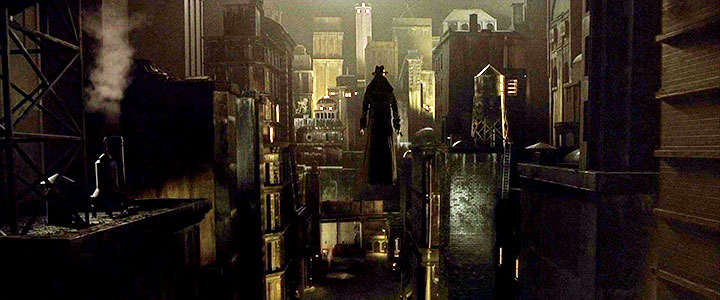
I vaguely remembered Dark City being advertised, but only knew one person who saw it in theaters and they told me it was just ok. So I was surprised when I saw at the end of the year that it landed at #1 on Roger Ebert's year end top ten list. That made me want to check it out and see what was up. I did, and just thought, "it was ok". But then I started thinking more about the philosophy behind it, and especially the images contained within it. I was caught by the incredible German expressionistic architecture, and the subconscious evocation of old school noir movies (subconscious to me, because I didn't know much about noir at the time) and the paintings of Edward Hopper. So I bought it on DVD, watched it again, and liked it a lot. Then a few weeks later watched it again, and loved it. A few months or a year or whatever later, I watched it again and decided it was one of my favorite movies.


Dark City takes a different approach to "first contact", in that most people don't know that they've been contacted by aliens. We also get a different take on alien invasion, as the aliens in this case don't want to rule us, although they are unintentionally doing that. They want to learn from us. They want to grow as we grow, change as we change, but sometimes (again, as in Arthur C. Clarke's Childhood's End) certain species may be doomed to not be able to evolve. The Strangers may just be stuck with where they are right now. It may all be futile. This movie doesn't quite explore that idea as much as it explores the idea that The Strangers were looking in the wrong places for answers, as humanity does sometimes in our studies. Still, this movie brings up so many ideas of what it means to evolve, what memories mean to us, who we are inside of ourselves (do we have a soul?), what makes us human? Just as all great sci-fi does, it works as a straightforward story, but there is also so much there to explore underneath the surface if we desire to look at it.


In 2008, director Alex Proyas released his Director's Cut of the movie. I'm not normally a fan of Directors Cuts, but this one took one of my favorite movies and turned it into an all-time top 5 for me. The theatrical cut is like a sprint, the quick cutting and relentless pacing rushing towards the final confrontation. The DC adds in just a few scenes, but Proyas cuts them in in a way that lets the movie breathe and not exactly take its time, since it is still paced quite rapidly, but feel like it's not the sprint to the finish line that the original cut is. I listed it last year as one of the most beautiful movies ever made, because it can be viewed in slow motion and just taken as a moving painting and it still works. Roger Ebert said so eloquently in his original review (he's since written another one, when he added it to his list of "The Great Movies", as well as doing a commentary track for the DVD) and I can't top it, so I'll just close with this quote "If it is true, as the German director Werner Herzog believes, that we live in an age starved of new images, then Dark City is a film to nourish us. Not a story so much as an experience, it is a triumph of art direction, set design, cinematography, special effects--and imagination."

Thursday, November 1, 2018

Top 10 Action Movies

What makes a great action movie? Surprisingly, the answer isn't just great action sequences, because what makes a great action sequence? I would say that more than anything, what we need for a great action movie is characters. We have to care what happens to these people. If we don't, what's the point? If we don't care, then it's just things banging into each other and we lose interest. This is the problem with movies like the Transformers movies. They're just special effects created by an expensive bunch of animators. There's not a character there that we care about. So that becomes the trickiest thing in an action movie, because just having action, and lots of it, isn't enough. We have to care. But then there can also be instances where just the visceral nature of the action can be enough to elevate a movie thin on character. Obviously the ideal thing is to have both, but sadly that doesn't always happen.

Honorable Mentions for:
Mad Max Fury Road
Casino Royale
Fellowship of the Ring
Kill Bill
Crouching Tiger, Hidden Dragon

10. Dredd
Credited to director Pete Travis, but according to the cast mostly directed by writer/producer Alex Garland, Dredd is very much indebted to video games in its structure as Judge Dredd (a perfect Karl Urban) and his apprentice Judge Anderson (Olivia Thirlby) must methodically make their way up floor after floor of a high rise building to take down drug lord Ma-Ma (Lena Headey). The characterization is thin, I must admit, but our leads really sell it. Headey is just unhinged enough to feel dangerous, but such a tremendous actress that she brings humanity into anything she does (she is so much more than just Cersei Lannister if you’ve only ever seen her in Game of Thrones). Urban is just perfect in what is really a one note character. Dredd is hardcore, the ultimate rule follower, the ultimate enforcer, and so would seem to not have any available growth to him over the course of the movie, no emotion, but Urban makes it work somehow. But the key to the emotional arc of the movie and making it work is Olivia Thirlby. Probably most known as Juno’s best friend, she gives a performance of strength through adversity, inherent decency, and also a bit of wide eyed innocence to this relentless, dark, grimy, violent world. She’s our “in” to this world. She’s the audience surrogate. It’s her story more than it is Dredd’s, because she’s being reviewed on her abilities as a Judge. Thirlby has impressed me in other movies I’ve seen her in as well (most especially David Gordon Green’s Snow Angels) and I really wonder what happened to her. She needs to work more. But still, she’s the one we worry for. She’s the reason the action is tense, from a character perspective. Dredd seems like a perfect machine, it’s Anderson that’s learning her way as a Judge.

9. Predator

Get to da choppah!

Predator has so many stupid lines of uber-macho dialog and male preening of muscles and machismo that it’s comical. It also is an extraordinarily tense jungle set riff on Agatha Christie’s Ten Little Indians with special effects that still work today, and visceral kinetic action scenes that don’t let up until the movie is over. Director John McTiernan made many great action flicks in his time, like Hunt for Red October, The Thomas Crown Affair, and including his Predator follow up, which we will get to later in this list. It’s McTiernan that keeps this movie from teetering over into parody, as we can feel the jungle setting and it’s what really helps this movie succeed. We can see and feel the sweat, the heat, the fact that you can’t see anything beyond the wall of vegetation in front of you. Each element ratchets up the tension beautifully. When the action comes, the Predator is efficient and brutal and all of the sudden we’re down another crew member. Neither McTiernan nor the Predator draws anything out too much, and that’s what works so well. Things can change so quickly that everyone must be on guard at all times. There’s no quiet before the storm, because the storm is quiet and all around you. It’s a wonderfully intense movie, and I wouldn’t really argue with someone who said it’s too low on this list.

8. Jurassic Park

There are, honestly, not a ton of consistently great directors in the action world. There are filmmakers that have a few great ones here and there, but few who deliver time and again. Steven Spielberg might be the king of action directors in my book. From the finale of Jaws to the horror of Saving Private Ryan to the entirety of the Indiana Jones series. In fact, Duel almost made it on this list since it’s one of the most relentlessly thrilling and tense movies ever made. But I decided to go with Jurassic Park, one of the most fun times you can have at the movies. The T-Rex attack, the raptors, the cgi that doesn’t look as seamless today as it once did, but still 100% works in the storytelling of it all, there’s a plethora of action here. But Spielberg also peoples the movie with characters and great actors to play them. Sam Neil gives terrific work especially in the first scenes where they see the dinosaurs. You can see the little kid inside of him bursting out. Jeff Goldblum, Richard Attenborough, and Laura Dern are wonderful as our other leads, while little parts like Wayne Knight and Samuel L. Jackson really create a great cast as a whole. I have watched this movie every couple of years since I was that 10 year old dinosaur lover seeing it in the theaters, and never once have I failed to be thrilled by this.

7. First Blood

I think people sometimes forget that Sylvester Stallone can be a terrific actor. I think First Blood might actually be his best work. It's a gritty, dirty, kinetic movie. It also subtly deals with the hassle that many Vietnam veterans dealt with after they came back. They had to go through a lot of shit in war, only to come back home and not be hailed as heroes like their father's generation when coming home from WWII. Back then the bad guys were more clear cut. Nazis = bad. Vietnam wasn't so black and white. It was all gray and these soldiers were the ones who really dealt with the gray of it all in a real way. We watch as Stallone's John Rambo just wants to live his life but gets hassled by some asshole cops and you could say Rambo overreacts to the situation, but we get it. The grimy, dirty, kinetic action focuses on a mostly wordless performance from Stallone, but it's great work from him as an actor.

6. The Bourne Identity

That's right, The Bourne Identity, the first one. Not the Paul Greengrass directed sequels which did everything this movie started to do, but with shaky cam. In Identity, Doug Liman knows how to actually show us what's happening so that we can care. We watch one of Matt Damon's best performances as the man of few words, Jason Bourne, as he tries to put his life together. Little details are what sets this apart for me, like before the car chase, as Bourne asks his companion, the great Franke Potente, if there's anything wrong with the car, does it pull a little to one side or anything like that. She has no idea what's about to happen, but he's trying to figure out what tools he has to work with. It's that kind of detail that really adds to the suspense, and the humor in the movie. We know why Bourne is asking, but she doesn't.

5. Die Hard

One that I'm sure most people would expect to be higher, Die Hard is a frustrating movie to me in some respects. Everything with Alan Rickman is brilliant. Everything with Bruce Willis is tremendous. Everything with Reginald VelJohnson is great and funny and adds to the tapestry of characters. However, Paul Gleason's idiotic police chief is only there to be wrong about everything. He's a buffoon in a movie with very few buffoons. The same can be said of the two FBI agents in the movie. They're superfluous and instead of just being part of the tapestry of characters, because they're so annoying they take away from the experience of the movie. They're 1/10 characters in a 10/10 movie. So I can't watch Die Hard without taking it down a peg because of them. Other than them, what more is there to say about how fun Rickman is, and how relatable and just leading man cool Bruce Willis is? Get rid of those other guys and this movie might top the list. As is? I can't have it higher than this.

4. Terminator 2: Judgment Day

James Cameron, at his best, has always been one of our best action filmmakers. His crowning achievement, though, in my mind, is T2. From the first time I saw it, at the probably too young age of 9 or so, I loved it. I was thrilled by it. I was excited by it. Again, the characters are what makes this piece truly sing. Linda Hamilton as the seemingly unhinged, but really apocalyptically prepared and determined Sarah Connor. A long way from playing in Beauty and the Beast on TV just a couple years before this. I know a lot of people find Edward Furlong annoying in his part as John Connor, but I think Furlong perfectly captures a kid who hasn't been parented in his life. He's young, he's arrogant, confused, not as smart as he thinks he is, and yeah he gets whiny. That's a kid. Contrasted against Arnold's Terminator and his silence and strength, it's a great dichotomy from a storytelling standpoint. And on top of all of that, one of the great villains in Robert Patrick's T-1000, and just one amazing action set piece after another throughout the whole runtime. You can't even really pick a favorite, because Cameron seemingly tells the story through the action, so the action is constant, and beautifully choreographed, shot, and just expertly put together. It's just an awesome movie.

3. Lethal Weapon

Again, characters. You could say archetypes, the "nearing retirement cop" and the "loose cannon cop nobody wants to work with", but aren't most characters just archetypes until the writers and actors get ahold of them? Danny Glover grounds the movie so much as a man that loves his family, is good at his job, and is just wanting to survive the craziness that's about to ensue. Mel Gibson embodies the loose cannon as a guy happily on the verge of suicide at any moment. Gibson is the movie's key. He could've been just a rogue, the guy that bucks the system, or whatever. But why is he suicidal? He misses his dead wife and can't move on without her. But he loves his job, and he's good at it. He brings the edge that Glover doesn't have. So they're a balance for each other characteristically. Add into all of that the sheer visceral thrill that director Richard Donner brings. Donner had done The Omen, Superman, and Goonies. He could do so much, but his crowning achievement is the way he calmly lays out these characters before letting shit hit the fan as we watch these guys go up against the bad guy drug dealers. And they too shouldn't be undersold, with their mix of the calm guy (Mitchell Ryan) and the loose cannon (Gary Busey). That Gibson and Busey would later be revealed to be loose cannons in real life only makes this movie work better, I think.

2. The Incredibles

So unlike movies like Mad Max, where we can marvel at the real stunt sequences and stunt performers risking their lives to get us these great shots and moments, The Incredibles was made entirely in a computer. So what makes the action so good? I think it's what I said in the opening paragraph: the characters. We have a whole family of people that we care about. They're all different, we like them for different reasons and their superpowers affect the story and action in different and exciting ways. I am thrilled by the action in the movie because I fear for the safety of these children that are just learning to accept and use their powers. Their parents know this action, they've fought all the bad guys before, so we don't worry as we watch them use their powers in a myriad of ways to defeat the enemy. We worry about the parents because of what all of this adventure means for them and their relationship. He's scared of losing his family, physically, to dangers. She's worried about losing their family to his desire to relive the glory days (and missing what's going on now, being present in the moment). So each character is risking different things, and risking them differently. When you add in the main action set pieces of the movie, they're almost unparalleled. The attack on the plane is my favorite, as Helen thinks she's flying to find her husband Bob, only to find out that the two oldest kids have stowed away on the plane, only to then be attacked by the bad guys forces. To see Helen's journey of fearing for her children, raising the stakes for her personally, and see it in her eyes and hear it in Holly Hunter's voice. It's extraordinary action filmmaking at the highest level. As a parent it brings tears to my eyes. As an action fan it gets me on the edge of my seat.

1. Children of Men

Not only one of the great sci-fi movies ever made, or just plain greatest movies ever made, Children of Men doesn't often get thought of as an action movie, but it definitely is. The two most memorable sequences from the movie (the attack on the car, and the outbreak of violence in the city) are two of the greatest moments in action filmmaking history. The attack on the car is a single shot, one that starts innocuously as the group drives down the road, but when they're met by motorcycle riding terrorists, shit goes down and we never cut away. We're never allowed to take a breath. Director Alfonso Cuaron has always had a fascination with single takes, and didn't always have to have them actually BE a single shot. In his take on Great Expectations there's a phenomenal sequence where Ethan Hawke's character leaves where he is and walks across the city to get Gwyneth Paltrow. It's multiple shots stitched together but plays like a single shot, giving a romantic momentum that a conventionally shot sequence just wouldn't have. The battle in the city near the close of Children of Men is the same thing. Although it's multiple shots stitched together, it plays as a single and is why it's one of the great action scenes of all-time. Just like the attack on the car, we're not allowed to breathe by the camera not cutting away. We hold it in, waiting for the inevitable edit that allows us to subconsciously distance ourselves from the action taking place on screen. Cuaron brilliantly denies us that edit for as long as possible, and does it over and over throughout the movie, not just these two sequences. It's the approach to that action that lets us BE in the action with our characters. It's what makes this my favorite action movie.

Wednesday, October 24, 2018

Top 10 Mob/Mafia/Gangster Movies


The mob movie has always been a favorite genre of mine. The mafia fascinates me in its strict moral code inside a world of crime. An "honor amongst thieves" kinda thing. That dichotomy is endlessly fascinating to me as a viewer, and has so many possibilities for storytellers within it as well. Although gangster movies have been around basically as long as movies have been, it all really got started in the 1930's, making big stars out of actors like James Cagney, Paul Muni, and Edward G. Robinson. And there's great hidden gems from this era as well, like The Petrified Forest with Humphrey Bogart in his first lead role alongside a hot young Bette Davis. Although the genre kind of morphed into the noir movies of the 40's and 50's, I think of that as a separate genre (and upcoming list), the gangster movie made a comeback in the 60's and 70's with movies like Bonnie and Clyde and Mean Streets. It hasn't really gone away since then.

Sometimes there are blurred lines for the genre, where movies like the heist film Rififi, one of my all-time favorite movies, is often considered a "gangster movie" because it deals with criminals committing a robbery. But there doesn't seem to me to be much connection to the mob itself in the movie. Maybe I'm misremembering things, but it seems more like criminals that have formed a group to do a job, not Mafioso. Then there are movies like In Bruges, which is about gangsters, but not about them necessarily doing gangster things. It's more about the aftermath and repercussions of gangster life. But it doesn't feel like a gangster movie to me. So I didn't include it even though it would be high up on the list if I did. Maybe that's semantics, but there are some great movies that didn't end up on my list because of this distinction.

So, anyway, onto the list!


Honorable Mentions: Casino, Once Upon a Time in America, A History of Violence

10. Road to Perdition

One of the most beautiful movies ever made, shot by the great Conrad L. Hall (who succumbed to cancer just two months before he could accept the Oscar for Best Cinematography, which was his third such award), Road to Perdition is an amazing movie unto itself, not just because of its wonderful look. Thought of at the time at "the movie where Tom Hanks tried to be a bad guy", the thing is that the movie works because Hanks is cashing in on his innate charm to get us to like a man who doesn't express himself very much, not to his wife or his sons, but we like him anyway. Another actor could've made the character a blank slate, but with Hanks you can see there's a lot going on under the surface, he's just not articulating it. When he needs to avenge a murder, we see the fire in his eyes even though we also see the pain and anger he isn't expressing. It's a remarkable performance, one of the best of Hanks's considerable career. Paul Newman deservedly was nominated for an Oscar for his powerful work, and guys like Daniel Craig, Tyler Hoechlin, Stanley Tucci, and especially Jude Law turn in terrific performances as well. This movie isn't as widely known as it should be, I don't think.

9. Donnie Brasco

Ah, the movie that showed me what a charismatic actor Johnny Depp could be, before he became a parody of himself. Paired up against Al Pacino, most actors would get upstaged, even with Pacino in one of the lowest key roles of his career (and one of his best). Depp plays Joe Pistone, a real life FBI agent who went deep under cover in the mob under the name Donnie Brasco. We watch as Joe tries to balance the mentality of being a gangster so that he can pass in the world of the mob, with the home life he has with a wife who hates his job and how it leaves her feeling like a single mother. Anne Heche is great as the wife, who gets a bit more nuance than in most similar movies. She feels like she's losing her husband, as when he is able to come home, he doesn't act like Joe, he acts like Donnie. The hurt on both of their faces when he tells her "I'm not becoming like them, Maggie. I am them." and you can see how he's hurt by this work too. It takes a toll on him too, the filmmakers don't just make it her problem. The scenes with Pacino showing Depp the ropes and roles and nuances of the mafia are really fascinating stuff. Perfectly acted by both actors. I wish it ended with Pacino's last scene, which gives the emotional ending of the movie, instead of the more logical resolution and crime statistics we get as the end of the movie, but that's a minor quibble.

8. The Departed

Maybe the most compulsively watchable movie Martin Scorsese has ever made, even more than Goodfellas, there's something about The Departed that I always go back to. It's not even in Scorsese's top 5 movies, but it is astoundingly well directed, well shot, and well edited. It just flows, it's told so fast that I get sucked in every time. It moves so quickly that the 2.5 hours fly by, and I think it's a fun game of cops and robbers and double crosses and all that. It's filled with terrific performances as well, especially from Leonardo DiCaprio and Matt Damon, who both say so much with their body language and eyes that they aren't saying with their dialog. Two great performances from two of our best star actors. It's not perfect, it does start to drag after Jack Nicholson is gone, but not because it misses his performance (which is fine, although it's one of the weakest in the movie), but because his character was the lynchpin of so much of the tension of the movie. Regardless, it's a great movie.

7. Scarface

Brian De Palma's remake of the Howard Hawks classic Scarface is one of the most garish and over-the-top movies ever made. It's not just Al Pacino's so-far-over-the-top-it-can't-even-see-the-top-anymore performance, the whole movie is garish, violent, loud and excessive. Almost 3 hours in length, I will admit that it is far too long. But I find Pacino so infinitely watchable in his role as Tony Montana that I never complain that the movie keeps going. Tony is loud and garish as well, but what people rarely talk about when they talk about this movie is that Tony is very funny. I almost think of the movie as a comedy, but intentionally so. Whether Tony is watching TV while soaking in the bubble bath and cheering on the flying pelicans, or getting kids to watch while his friend gets rejected by a woman, Tony makes me laugh so much. Sadly, like most gangsters, Tony lets power, money, women, and drugs take him down. In thematic resonance with his movie, Tony succumbs to excess. Honestly, my biggest complaint about the movie is actually Robert Loggia, an actor I always liked, who I think gives one of the worst performances I've ever seen. His accent is awful (say what you will about Pacino's, it's consistent and it works), his line deliveries are grasping for over-the-top but failing, it's just terrible work from a normally reliable actor. I still love the movie, but needed to say that about it.

6. The Godfather part II

We can just start with this: The Godfather is the best movie in its series, not The Godfather part II. The reason that Part II isn't as good is that the narrative doesn't quite work. By switching between the storylines of Al Pacino's Michael Corleone and Robert De Niro's Vito Corleone a generation before, each is robbed of its momentum, instead of building through the parallel struggles of power that tie the two together thematically. Francis Ford Coppola has said that he played with cutting back and forth twice as much, but it ended up feeling too chaotic and messy. I think that's because both are too self-contained. Yes they thematically tie together, but they're also narratively disconnected and don't ever come together. So what happens is that even though both pieces are brilliant, they don't fit. And the way the story unfolds, just as Michael's story is really gaining narrative momentum, it switches to Vito's story. Once Vito's gets going, to where we can't wait for the next scene, it switches back to Michael's. Neither is ever allowed to gain the full head of narrative steam that they both deserve. Each would be better as their own 90 minute movie rather than a single 3+ hour film. So why, even after all that complaining, is it still number 6 on this list? Because both of those 90 minute movie would be a 10/10 in my book. It's just that The Godfather part II doesn't become more than the sum of its parts when those two sections are cut together.

5. Eastern Promises

A story set in the not often explored Russian mafia in London, Eastern Promises contains one of the great performances of the 2000's in Viggo Mortensen's Nikolai, and also one of the most famous scenes of the decade, a fully nude fight scene in a Russian bath house between Nikolai and two assassins. It's a brutal scene, Nikolai is exposed in every sense of the word, vulnerable, it's dangerous and tense and lasts way longer than you might expect. Also at the center of the movie is the unpredictable Kirril (Vincent Cassel) and his coldly powerful father Semyon (Armin Mueller-Stahl), Nikolai's superiors in the mob, and Anna (Naomi Watts) the non-mob affiliated midwife who has gotten caught up in this world. It's a gangster movie with no guns, set in a side of London we've never seen before, but given the form of a mob movie (and with the outsider Anna as the true lead character) we have no trouble finding our place in this world. I think it's the best work of director David Cronenberg's great career. Also proof that Watts and Mortensen are two of our very best actors working today.

4. Miller's Crossing

Miller's Crossing is a movie that didn't connect to me totally the first time I watched it. I was expecting something more epic in the vein of The Godfather, or something more kinetic and influenced by Scorsese. Instead, Miller's Crossing is more influenced by the noir novels of Dashiell Hammett (specifically Red Harvest and The Glass Key), and mixed a sense of weight through Barry Sonenfeld's sumptuous photography and the Coen Brothers' sense of humor and style. It's a gorgeous movie, so labyrinthine in its plot that the Coen's had to put the script down and write Barton Fink to give themselves time to work through the complexities. Gabriel Byrne is perfect as the classic noir hero, the smartest guy in the room, but not so smart that he avoids being doubled crossed or getting his ass kicked on occasion. Albert Finney is wonderful as the egotistic mob boss. Marcia Gay Harden is a great femme fatale, playing Byrne and Finney against each other while she protects her brother, John Turturro, who's the weakling that puts the whole plot into motion. Maybe because I knew more what to expect, and had much more familiarity with intricate noir plots, I loved Miller's Crossing when I went back and watched it a few years ago. It became one of my favorite movies from the Coen's, and definitely one of my favorite gangster movies.


3. Goodfellas

“As far back as I can remember, I've always wanted to be a gangster”

Goodfellas follows the story of the half-Irish Henry Hill (Ray Liotta) and his attempt to rise in the ranks of the New York mafia from the mid-1950’s through the late-1970’s. Being half-Irish is an important component in Henry’s story because it prevents him from ever becoming a “made guy”, as only those with 100% Italian blood can ever be “made guys”. The same hurdle blocks Henry’s mentor Jimmy Conway (Robert De Niro) as well. However, as a child Henry is paired with the sociopathic Tommy DeVito (Joe Pesci) who as a full blood Italian could one day rise to made status. Ray Liotta, Robert De Niro, and Joe Pesci provide wonderful portraits of these psychopathic characters who do what they do (steal, kill, etc.) because they enjoy it and not for any other psychological or sociological reasons. Lorraine Bracco gives a great performance as a wife adjusting to a mafia marriage, which is a nice character to see Scorsese and co-writer Nicholas Pileggi take advantage of, as the “wife” is usually ignored in mafia/crime movies. The use of period music and subtle aging makeup allow a believable journey through the years with these characters.

In addition, Thelma Schoonmaker and Michael Ballhaus deserve infinite praise for their work on the editing and cinematography, respectively. Ballhaus’s roving camerawork helps us feel personally involved in these people’s lives, and Schoonmaker’s propulsive editing makes the movie feel alive with energy and easily the quickest 2 ½ hours in movie history. The most obvious examples of Ballhaus’s great work is the famous tracking shot in the Copa, and the great camera work during a certain section of the movie scored to the piano section of “Layla”. Schoonmaker’s genius in particular shows during a bravura sequence where Henry spends a frantic, paranoid day where he believes an FBI helicopter is following him as he dashes all over town running guns, tries to organize some drug trafficking, and attempts to cook dinner for his family (“don’t let the sauce burn” he repeats).

That said, some people may be bothered by both the language (the “f” word is used an alleged 300 times in the movies 145 minutes) and the violence. These characters are not nice people, and the fact that they show no remorse for their actions may also disturb some. The movie is not overly graphic in terms of gore, but there is no shortage of violence depicted on screen.

2. Pulp Fiction

Quentin Tarantino's Pulp Fiction hit the movie going public like a lightning bolt in 1994. Its unashamed use of violence and creatively foul language offended a good deal of the people who went to see it (there were actually a number of boos from the audience when it took home the Palme d'Or, the top prize at the Cannes Film Festival). It also hit me like a lightning bolt when I first saw it at about the age of 12 or so. It was the first movie I'd remembered seeing told out of order (no, I hadn't seen Citizen Kane by 12, nor had I seen Tarantino's debut, Reservoir Dogs) and the stunning dialog really lodged a place in my young brain. Tarantino's skills as director also had quite an impact on me, building tension in some scenes, hilarious comedy in others, and his use of music struck a significant chord with me back in those days of not knowing just how much he was stealing from Martin Scorsese, Elmore Leonard, and others.

So many movies that hit you at a young age simply don't continue having the same sort of impact as you get older. Pulp Fiction, though, still thrills me and makes me laugh (it's one of the great dark comedies at its core), nearly as much as when I was 12. There's not really a whole lot more to write about one of the most written and talked about movies ever made. Not for everybody, but definitely for me!

1. The Godfather

Yet another one that didn't hit me on first viewing. I'm not quite sure what it is about some movies, but many of the greats tend to grow on me. I don't remember when I first saw The Godfather, like Star Wars it seems like I have always seen it. But it didn't become one of my favorite movies until years later, when its combination of amazing photography, mesmerizing acting, and flawless script catapulted it to the top of my favorites list. I read the book while I was in the 8th or 9th grade, and had been disappointed when revisiting the movie, since it didn't go into the entrancing detail that the book went into. Over time, I realized that what Coppola and author Mario Puzo did when writing the script was to pare away the fat from the book and focus simply on the Corleone mafia family as the balance of power shifts through the generations. In fact, I had to read the book to find out some of the motivations for things that I didn't understand in the movie. As it turns out, the motivations for every action are there in the movie, we've simply not been conditioned to watch movies as densely constructed as this. However, even if you're not concerned with the intricacies of why everything happens, you can still be enthralled with the overall story, or at least with this incredible assembly of actors, all doing some of the best work of their careers.

There's no reason to relay the plot, or the famous quotes, or the things that have become part of pop culture since the movie's release. But one thing I find continuously fascinating is that honestly there aren't many "good" people in the movie. Coppola keeps things completely contained within the world of the mafia. Really only Diane Keaton's Kay is a good person, but she's not our protagonist. Somehow, storytellers have always been able to get us to identify with the less desirable members of our society. Vito, Sonny, Michael, Tom, and even Fredo are perpetuating the evil cycle of crime that the Corleone family is a member of. No matter that these aren't people we would necessarily want to know in real life, we worry for Vito's safety, Sonny temper, Fredo's weakness, Michael's descent from good to evil, and the future of the family. I never fail to be saddened by the last shot of the movie, as Michael finalizes himself and his family in the biggest position of power in the mob world.

Of course, you could praise everything from Gordon Willis's influential photography (for which the master somehow didn't even get nominated for an Oscar) to the flawless production and costume design, Nino Rota's famous score, everything. It's one of the most thoroughly well made movies I've ever seen. But none of that would make The Godfather as esteemed as it is if it wasn't so layered, powerful, and damn entertaining to watch. There's a reason so many people consider it the best movie ever made. I have to watch it every once in a while and I never fail to love it even more than I did the last time.