Thursday, October 27, 2016

Adventureland


Movies like Adventureland are rare. They see their characters lovingly without idealizing them. They see a place and time so truly that we forget we are watching a period piece. They remember what it felt like to be young and in love. Remembering the friends you wished would go away when you were trying to talk to a girl, the awkward silences you’d endure before you figured out how to really talk to women, the feeling of what it's like to be accepted by the one person you hoped would accept you, and the myriad of memorable people that may only come into your life during the course of one crazy summer. So, it’s a coming-of-age tale, a genre I’ve always loved. And technically there’s nothing new here, but it’s about as good of an example of the genre as there is.


It's 1987 and James (Jesse Eisenberg) is forced to get a summer job when his dad gets demoted at work and his parents aren't able to help him pay for his college graduation trip through Europe or pay for graduate school and an apartment in New York City. After being turned down by everyone because he has no job experience (despite his degree, “I’m not even qualified for manual labor” he complains), James gets a job at Adventureland, the local theme park. There he meets the oddball managers Bobby and Paulette (Bill Hader and Kristin Wiig), who put him to work in the games section of the park alongside Joel (Martin Starr) and Emily (Kristen Stewart), whom James quickly falls for. He also gets to be friends with the guitar playing maintenance guy Connell (Ryan Reynolds), who people say jammed with Lou Reed, one of James' heroes.


Adventureland is the most wonderfully realized, delicately crafted, and emotionally affecting movie about young people that I've ever seen. It captures a moment in time that didn't even exist in my life, yet I connect to it so deeply I almost can't explain it.

There's not a single moment in the movie that rings false to me, and so many moments that transcend the maligned "young adult/teen" genre. Of course, this movie is not about "teens," it's about people just out of college realizing that their studies in Comparative Literature or Russian and Slavic Languages don't mean much in the real world. It's also about those fragile feelings of first love, real friendship, jealousy, and taking the wrong advice because you don't know any better yet. More than anything really, it's the story of first love. But because everything is so carefully constructed, capturing life, the feeling of real life, it's about much more than that simple description might allude to. Sure, it's not documentary-esque real life, it's idealized and nostalgic, but in the best way possible.


Jesse Eisenberg is just so subtly good as James that I'm afraid people will underestimate him as an actor. He’s gone on to do work both acclaimed (like in The Social Network, which netted him an Oscar nomination for Best Actor) and not as well received (like his recent turn as Lex Luthor in Batman vs. Superman). Here in Adventureland, Eisenberg has the kind of effortless charm and real emotions that John Cusack used to bring to these kinds of young adult roles in the 1980s. He has a bit of Woody Allen in his performance as well, but never comes off like a caricature or even an imitation of either actor. He's his own person. Many people who can’t look past the surface have written this performance off as “oh, he’s just an awkward teen, it’s the Michael Cera role.” And that’s wrong. Eisenberg brings a lot of depth and nuance to his role if you’re willing to see it.

Another polarizing actor, Kristen Stewart, is here so beautifully fascinating and charming that you can't help but fall in love with her at least a little bit. She brings a certain delicate intelligence to her character that I'm not sure many actresses her age could pull off. She’s not quite the idealized manic pixie dream girl that many love interests are in these types of movies. She’s a young woman who has been hurt, made mistakes, but is a good person, funny, and someone who stands up for and protects the people she cares about. It’s not at all hard to see why James falls for her.


In fact, each supporting performance is really spot on, with Martin Starr in particular being worthy of mention as James' fellow game booth worker Joel. He sees himself and the world around him with a clarity that none of the other characters possess, giving James the kind of advice that he needs, rather than the kind he's been taking from Connell. And Ryan Reynolds as Connell is the type of work he needs to do more often as an actor. Reynolds is usually best in small doses, I find, and so his scene stealing turn here is perfect and probably the best work of his career. Bill Hader and Kristen Wiig are the only really unrealistic supporting characters, but both are so funny and work so well together that I don’t really care.


Director Greg Mottola's previous movie, Superbad, was one of the most realistic depictions of teenage mindset, life, and emotions that I've ever seen (barring the McLovin storyline, which while hilarious was also that movie’s equivalent of Hader and Wiig). At the time, I gave most of the credit for that to writers Seth Rogen and Evan Goldberg, and stars Jonah Hill and Michael Cera. Adventureland makes me think that maybe a lot of that credit deserves to go to Mottola. He takes on writing duties this time, telling a semi-autobiographical story that he just flat out nails as director. The delicate narrative telling of this movie is really a wonder to behold. It’s episodic, but somehow Mottola makes it feel cohesive, as the emotions and even the comedy are all part of the whole tapestry of James and his summer at Adventureland.


Of course it’s a coming-of-age movie, but I still think it's a hard one to classify because everything in it works so well that it rises above those genre clichés. So yes it has comedy, drama, romance, awkwardness, friendship, punches to the crotch, and maybe a chase scene or two. But sometimes you watch a movie so good that you just sit in your seat and hope it knows how amazing it could be if it doesn't screw it up in the end. Adventureland is that kind of movie, and it never falters once.

Defending Your Life


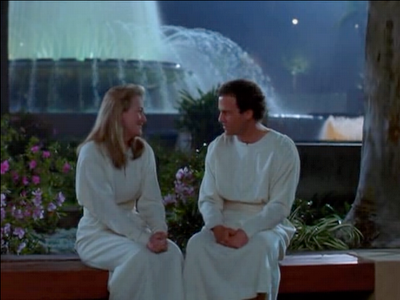
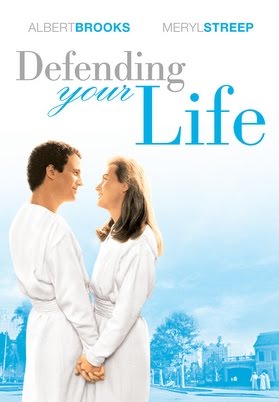
Albert Brooks is one of the great comedy talents. Though many people today might know him best for his starring role as panicked father Marlin in Finding Nemo, he was never better than when he took complete control of his work in the Woody Allen vein of writing, directing, and starring in his own movies. He did this to great critical and commercial success with 1981's Modern Romance and 1985's Lost in America, along with his great supporting acting work in movies like Taxi Driver, Broadcast News, and just a few years ago in Drive. His work is a bit more specific than other writers, and so he was never destined to play to as big of audiences as he deserved. Still, his writing is layered with jokes big and small, rewarding re-watches of his work. Sadly, he's only given us seven feature films, but his masterpiece is most definitely 1991's Defending Your Life.


Brooks plays Daniel Miller, who dies in a car wreck. That's not a spoiler, it's the opening of the movie. Daniel gets sent to Judgment City, where he enters a kind of trial, though they don't like to call it that. In that trial, he must defend the actions he took in his life. It's not about making good or bad decisions so much as it is whether he let himself be ruled by fear or desire. If too much fear, then he gets sent back to Earth to try life over again. If the judges deem him worthy, he gets to “move onward.”


He's told by his defender, Bob Diamond (Rip Torn), that they'll be looking at nine days from Daniel's life. “Nine, is that a lot?” he asks. “It's not a lot or a little,” he's told, it just is. But to a neurotic guy like Daniel, nine sure sounds like a lot. He only meets one other person in Judgment City who's defending more, a pornographer who proudly claims to have coined the phrase “all nude girls,” and who is defending 15 days of his life. By chance, Daniel meets Julia (Meryl Streep), and they have an instant and powerfully romantic connection. Julia is only defending four days of her life, which makes Daniel worry that she'll move onward and he won't. When Daniel sneaks into her trial one day, he sees things like her saving her family from their burning house and her prosecuting attorney crying and saying "I just wanted to see that again" after Brooks' prosecutor (Lee Grant) has been relentless in saying he doesn't deserve to move on.


We've seen many stories that deal with what a possible afterlife might be like (including Warren Beatty's Heaven Can Wait, whose co-director Buck Henry makes a cameo appearance here), but I think Brooks' take is the most interesting. We're told there's no heaven or hell, a person either moves onward or they are sent back to Earth to give life another try. Daniel's told he's lived on Earth 20 times, which again seems like a lot to him. Bob Diamond tries to comfort him by saying “there are people who've lived life 100 times on Earth…. Now, you wouldn't want to hang out with any of them, but it happens.” There are fascinating pieces to Judgment City, including different hotels (Daniel's is a pretty basic one, while Julia's is an opulent Four Seasons or Hilton type), restaurants, and even the Past Lives Pavilion, where you can see up to five of your previous lives. Julia is fascinated to know she was Prince Valiant in a previous life, while Daniel has just seen himself as an African native running from a lion. When Julia asks who he'd been in his previous life, Daniel responds “dinner.”


Defending Your Life turned 25 years old just a few weeks ago, and it's remarkable how little it has become dated. Because Brooks' ideas are big and weighty, but he let the story be driven by emotion and reflection of one's life (things that will never grow old), and his writing is so sharp, the movie plays in 2016 much the same it would've played in 1991. There are terrific jokes in the movie, like when Daniel and Julia meet at a comedy club in Judgment City where a horrible comic is struggling with the audience, the comic asks Daniel “How'd you die?” “On stage, like you.” Or maybe my favorite exchange in the movie is a conversation between Daniel and Bob Diamond. Bob has made a previous point of telling Daniel he uses 48 percent of his brain, whereas Daniel only uses 3 percent. When Bob misses a day of the trial, Daniel wants to know why.

Daniel: Where were you? I'm just curious.
Bob: I'd tell you, but you wouldn't understand.
Daniel: Don't treat me like a moron. Try me.
Bob: I was trapped near the inner circle of thought.
Daniel: I don't understand.
Bob: I told you...


Rip Torn is just dynamite in that role. He brings a certain indefinable, unhinged something to that part that makes you really believe he's this guy who has long since moved on from his life on Earth. Brooks, too, is tremendous in his typical intellectual, neurotic guy character that is similar in a way to Woody Allen's, but there seems something much more adult about Brooks, more mature in his character. He plays up the angst and nerves that are wrecking Daniel's life by keeping him from his desire. And Brooks the filmmaker is on top of his game with confronting this idea that, as Bob puts it, “Well, everybody on Earth deals with fear - that's what little brains do. Fear is like a giant fog. It sits on your brain and blocks everything - real feelings, true happiness, real joy. They can't get through that fog. But you lift it, and buddy, you're in for the ride of your life.”


Special mention has to go to Meryl Streep's performance. This was the first time we'd ever seen her be an engaging, regular person on screen. She'd always played any number of difficult and challenging roles, but from all accounts is a lovely, warm, friendly person, and that's who she plays here. She radiates comfort and lovability, and has a magical chemistry with Brooks because of it. The movie doesn't take off if the surprise love story doesn't work, but that's not a problem here. It's obvious why he's drawn to her, because we are too. She's funny and charming, and more than a little sexy. Although they're only together a few days, we don't doubt for a moment that there's obviously some bigger force of love happening between these two. It's really what helps take the movie from great to transcendent.


Defending Your Life has gained a small but passionate following over the last 25 years, but it is still firmly a Hidden Gem. It has ideas and jokes both big and small, beautiful romance, incredible after-life world building, and is just a tremendously enjoyable and thought-provoking time at the movies. What more could you want?

The American


The American is a startling and brilliant movie for a multitude of reasons. It contains one of George Clooney’s best performances, is shot mostly in the picaresque Italian countryside, and is the engagingly subtle tale of an assassin hiding out in a small Italian village. It was directed by Dutch filmmaker Anton Corbijn, whose background in photography is obviously present in every meticulously beautiful frame of this movie. Although it made money at the box office (opening #1 and making $68 million on a $20 million budget), it was hated by audiences, resulting in a D-minus Cinemascore rating and an audience approval score of 38% on RottenTomatoes.com (its film critic number was the just barely “fresh” 66% approval). I think this is because it was marketed incorrectly. This is a slow, cerebral movie more in the vein of Jean-Pierre Melville’s Le Samouraï than it is the “Clooney as Bond” movie that was marketed. And I’m thankful for that; we need more movies with a brain in their head like this than we need another Jason Bourne knock-off.

Based on British author Martin Booth’s spy novel A Very Private Gentleman, The American follows Jack (Clooney) as he flees Sweden, running from men who are trying to kill him. We’re not sure why, but Jack’s handler Pavel (Johan Leysen) says it’s because Jack has lost his edge now that he’s getting older. Jack goes to where Pavel sets up a safe house in Italy, but a paranoid Jack runs away on his own to a different town. He’s eventually set up with a job to make a gun for Mathilde (Thekla Reuten, the innkeeper from In Bruges). While in the town, Jack becomes involved with local prostitute Clara (Violante Placido), despite Pavel advising not to “make friends” with anyone, telling him “you used to know that.” Jack also crosses paths with local priest Father Benedetto (Paolo Bonacelli), with whom he has many philosophical conversations. But Jack never lets down his guard, even as we can tell he wants to for Clara.

Violante Placido, as Clara, is kind of the heart of the movie, at least in regards to what she means to Jack. Placido is even more beautiful than her mother Simonetta Stefanelli (whom most of us know better as Michael’s Italian wife Apollonia in The Godfather), but with the same expressive eyes, sweet smile and intriguing Italian sensuality. Her Clara is the classic hooker with a heart of gold, but nothing about her feels standard to me. Her performance has depth to it, even though most of the story focuses on Jack and how she relates to him.

Possibly the best scene in the movie is one in which they go out on a real date at a restaurant and her girlish excitement at being with a guy she could actually connect with is endearing. When a man comes over selling roses and she tries to shoo him away, trying to tell Jack, “He thinks we’re a couple,” Jack retorts simply with “It’s okay.” The look in her eyes, seeing that Jack isn’t embarrassed she’s a prostitute and actually enjoys being with her, being seen with her, and thought to be her guy, almost brought tears to my eyes in what that means to Clara and how beautifully Placido expresses that.

But, of course, this movie works because of George Clooney. There may be no other actor as interesting to watch as he thinks. Jack’s mind is always going, even as he keeps a relatively stone faced exterior. Clooney says so much with his eyes and his body language, and even the tone of his voice, so much more effectively than most actors. He has always been able to sell that there’s a lot going on under the surface, and Jack is one of his best characters, easily on the level of Out of Sight’s Jack Foley or his title character in Michael Clayton. Jack is lost, at a crossroads in his life, and he’s a broken man in many ways. He sees possible redemption for himself in his relationship with Clara, maybe, as long as he can stop wondering if she’s a fellow assassin out to kill him.

Director Anton Corbijn and writer Rowan Joffé unfurl this story slowly, methodically, but never boringly. There’s not a wasted scene or even moment, really. Everything tells us something, as long as we’re paying attention. Corbijn’s photography here (along with cinematographer Martin Ruhe) is extraordinary. The movie is beautiful to look at, for sure, but it’s also framed so gorgeously and often in a way that assists the narrative. There are shots where there are things in the background that inform the foreground, or shots that show us the labyrinthine streets of the Italian mountain town, or ones that frame Clooney in a way that underscores what’s happening narratively. It’s a movie that could and should be studied by film students for the brilliance of the shot selection.

Corbijn’s allowance of silence in the movie is likely what turned off some viewers, but it’s what captivates me. He lets words hang in the air as we contemplate something as simple as two different people calling Jack “Mr. Butterfly.” Well, he has a butterfly tattooed on his upper back, which we’ve seen multiple times, but have both of these people seen it? Is it connection or coincidence that these separate people used those specific words? Jack doesn’t live in a world of coincidences. Other movies point out this kind of possible connection, but The American knows it made its point and doesn’t need to bash us over the head with it. It doesn’t insult our intelligence, it respects us as viewers.

Corbijn followed this with another spy story, 2014’s A Most Wanted Man, based on spy guru John le Carré’s novel. I haven’t seen it but want to, especially as it was the last starring role for Philip Seymour Hoffman, one of my all-time favorite actors. I love spy stuff, and The American has to go at or near the top of the heap for me. The Zen-like control of the movie, the cool restraint of Clooney’s performance, even the references to other spy movies (the code Mathilde wants on the briefcase that carries her gun, 014, is literally double O7). I think history will be kind to this Hidden Gem, much kinder than audiences were in 2010, as more people find it over the years divorced from the awful marketing that sold it as an action movie. It isn’t an action movie, but it is a great movie.

Upstream Color


Shane Carruth got strong notices (and many awards) for his 2004 debut film Primer, a mega-low-budget movie about two friends who stumble into inventing a time machine. Made for just $7,000, the film is remarkable in many ways. My favorite way is the elliptical and complex storytelling, so that we’re not always sure where we are in the timeline of the movie. Carruth feels no need to spell everything out for us, and has even said that although he had to figure out the complex timeline of the movie in order to make it, it’s not necessary for the viewer to. I love that he didn’t spoon feed us everything, or anything, but also that it’s not just a puzzle to figure out. You can work to figure out the logistics if you want, but it’s not necessary to enjoy the movie. There’s also the immortal line “Are you hungry? I haven’t eaten since later this afternoon.” Unfortunately, he struggled through financing his next picture, a sci-fi masterpiece of a script called A Topiary, before eventually abandoning it to make 2013's Upstream Color, which for my money is the best movie of the 2010s.

Upstream Color is a mesmerizing, hypnotic, nearly silent movie. Not silent like The Artist, I say it's silent simply because it relies very little on dialogue. There is plenty of dialogue in the movie, but it doesn’t rely exclusively on it to tell its story or convey ideas. The movie is more about the rhythm of the narrative, the extraordinary cinematography, and the overall sound design. Or I guess I should say that these elements are elevated more here than they are by other filmmakers. The sound design is integral to the story in a way you pretty much never see, and can’t really be explained unless you’ve seen it. Also low budgeted (though Carruth has refused to say, because he felt Primer got too much press for its budget and not for the movie itself, but I've seen estimates showing this one around $50,000), still absolutely gorgeously made, you’d never guess from looking at it that it was a low budget movie, except for the fact that it’s unlike any movie you’ve ever seen.


It's told non-linearly and often abstractly, but the basic story of the movie is that of a woman, Kris (played by the intriguingly beautiful Amy Seimetz) who is drugged and kidnapped by a man known in the credits only as Thief (Thiago Martins) who, through the drug he slips her (which has some sort of worm in it), is able to put her in a hypnosis-like state. Eventually he leads her to liquidate her bank account and all other money and give it to him, before he disappears. Somehow she’s then led, still in a hypnotic state, to the Sampler (Andrew Sensenig) a pig farming sound recorder, who removes the worm from her body and transfers it to that of one of his pigs.

Suddenly, Kris awakens in her SUV on the side of the highway, unaware of anything that has happened in the previous days. She returns to find her house littered with blood stains, things missing, food all over, and eventually no money in her bank accounts and fired from her job (go mysteriously missing for days with no explanation and this is what would happen). Later, on a train, she meets a man, Jeff (Shane Carruth) whom she has an almost metaphysical connection to. They fall in love, and both start to unveil their secret pasts and what happened to them, with more in common than we would've anticipated.


The story is told without any rush, with a beautiful, Malick-esque intermixing of natural and urban settings. Stolen moments helping to fill in the gaps of what would normally be a big Hollywood thriller of kidnapping and thievery. Carruth gives a nice leading man performance, but the star here is Seimetz, whose work is truly extraordinary. She gives Kris a look haunted from her past, but also her brief smile lights up her face and lets us see that Kris really is in love with Jeff. They weren't drawn together because of their pasts, they were drawn together seemingly in spite of them. Weirdly, I could continue detailing the entire plot and it still wouldn’t ruin the movie, but I’ll leave it there for you to discover on your own. The movie works the first time around, no matter how much you know about it. But like all the great pieces of art, it enhances upon each viewing as your understanding of it and emotional connection to it grows.

Now, you can't talk about a Shane Carruth movie without mentioning just what he did in it. From interviews I've seen and read, it seems more about keeping budget down than it is him being a stereotypical controlling artist, but still his credits on this movie are: Writer, director, producer, star, music composer, sound composer, editor, director of photography and one of the camera operators. There's certainly no doubt as to whose vision this movie is. It’s likely the only reason he could make such a professional looking movie on a budget so small, by doing nearly everything himself.


I first saw this movie in 2013 when it came on Netflix streaming (where both of Carruth’s movies still are), but it has stuck in my memory since then and I’ve revisited it multiple times. It’s always less confusing than the first time around. But even then, I didn't care that I was confused on a story level because Carruth had me mesmerized by every second and so it was more that I didn't know what to expect and wasn't always sure where we were headed. Now I know, and so the atmosphere works even better because I can give myself over to the movie and let it wash over me while also picking up on a ton of little things I'd missed in previous viewings. I "got it" the first time around, Carruth's movies don't beg re-watches because you don't understand every little thing, you don't need to. They beg re-watches because he respects the audience’s intelligence and refuses to explain every little thing to make sure we understand it. I enjoy Upstream Color much more than I did Primer (which I also really like) and will continue going back to it over and over again. And at just 96 minutes, Carruth doesn't overstay his welcome, he ends things perfectly and in a way that makes us want to enjoy the ride again and again.

We must hope that Carruth's next movie, titled The Modern Ocean and with a reported cast including Anne Hathaway, Keanu Reeves, Daniel Radcliffe, and Jeff Goldblum among others, will still be his vision. It’s reportedly “big budget” but with Carruth that could mean almost any number that would still be microscopic by Hollywood standards. Carruth has gained big fans like filmmakers Rian Johnson (Brick, Looper) and Steven Soderbergh, who has called Carruth "the illegitimate offspring of David Lynch and James Cameron." And Soderbergh has also said that if he ran a studio, he'd give talents like Carruth a decent budget and just let them go make whatever they want and sit back and be amazed at the result. Hopefully that’s what we can look forward to with The Modern Ocean. Carruth has already been nominated for many awards (including five Independent Spirit awards for his two movies, nominated for Best Director both times) so let's hope his next work of genius is as good as Upstream Color and comes much sooner than the nine-year wait we had to endure last time.

Box Office Prophets

At the beginning of this year, I started writing a monthly column for BoxOfficeProphets.com, called Hidden Gems. In it I try and shine a spotlight on movies that may not be unknown, but are underseen or undervalued, I feel. I've decided to re-post these here on my blog as well, so that I have all of my writing on my blog and none get lost in the shuffle. Some are re-worked or expanded from pieces I've written here before, but I've decided to re-post all of them except the first piece, on Big Night, since I posted that under my Top Films list, as it's my all-time #1 movie.

Tuesday, August 2, 2016

The Babadook

The Babadook is a movie I've heard about since it was first released at the Sundance Film Festival in 2014. It has an absurd 98% on RottenTomatoes, and William Friedkin (director of The Exorcist) said "I've never seen a more terrifying film. It will scare the hell out of you as it did me." But I also heard from a number of people that the movie was "overrated" "boring" and "not at all scary." So I wasn't quite sure what to expect. What I got is surely one of the great horror movies ever made, featuring flawless acting, a disturbing story, and wonderful execution of the idea from Jennifer Kent, a long time actress in her native Australia (where this movie is set) making her debut as writer/director here.
The story concerns Amelia (Essie Davis), a single mother who is really struggling to raise her 6-year-old son Sam (Noah Wiseman). She's lost her husband, and Sam is continually acting out in often bizarre ways, to the point that he's being kicked out of school. Amelia grinds through her days as a nursing home nurse, relying on the kindness of her sister and sometimes her neighbor to help with Sam. One night, at pre-bed story time, Sam takes a book from his shelf called Mister Babadook (rhymes with book, not duke), and has his mom read it. It's a pop-up book of frightening images and foreboding wording saying that the Babadook will come after you if you let it in. Sam is understandably upset and Amelia tries to get rid of the book. But the book finds its way back, Amelia begins getting frightening phone calls, and she also starts hearing and seeing things around her home.
A movie like The Babadook will only be scary depending on what you find scary from movies. For me, many horror movies never scared me. They're often just a character-less, emotionless, shallow exercise in gore. And gore isn't scary. The point of the movies are typically just to watch people get killed and then eventually the last person (often a woman, after Alien's Sigourney Weaver set that precedent) overcomes the killer and everything is alright. There are exceptions to the positive side, but more often the worst instincts of the genre are exercised and we get the recent trend towards "torture porn", a genre that literally only revels in the disgusting and graphic. Those hold less interest for me than any other type of movie. So if you enjoy those kinds of movies, if you find them scary, then The Babadook is unlikely to get your blood pressure up. For me, this is what horror movies should aspire to.
The Babadook works because it creates its setup, it establishes characters, and we begin to care (how many times have I cried in a horror movie, after all? Pretty sure this is the only one). The book doesn't even show up until about 30 minutes in, I think. But what transpires from there is more in line with the best psychological horror movies. Movies that work from the inside out, using our fears and doubts and not cheaply exploiting, but giving them voice and exploring them. The Babadook works not just on our fears of the dark and unknown, but also on our fears about the worst in us all. What about the dark side of human nature? What about the things we let in and fester within ourselves? Those don't have to be standard horror tropes. What do grief and anger and sadness do when left to their own devices? If we don't deal with our emotions and experiences, can't they make us go a little crazy?


Those questions are part of the central appeal of this movie. We begin wondering if Sam is disturbed mentally, if there are some serious things wrong. Eventually I came to think "what if he's seeing his inner demons manifested for real in front of him?" That's a scary thought. We then wonder if maybe Amelia is getting caught in Sam's delusions, only to have that flipped on us. Is Sam not the one who's disturbed? Is Amelia falling apart? I even wondered at one point if Sam was not actually there, and was instead a manifestation of Amelia's inner emotions she'd been ignoring.
The movie is mostly a two-header with Essie Davis and young Noah Wiseman carrying the heavy lifting. And boy do they shine. Wiseman gives one of the most nuanced, frightening, and best performances from a child actor I've ever seen. In the really intense scenes (some of which feature nothing but mom and son driving in the car), Wiseman's work really got to me and made me worry for Sam intensely. Davis, as Amelia, gives one of the great performances I've seen from an actress. She's troubled, she's at the end of her rope, she is seriously struggling, can't sleep, and has a handful of a child to parent. This is an aspect that might've not hit me 10 years ago, but as a parent, I could relate to so much in Davis's work. As the movie goes along and really ramps up, had Davis hit a false note in any way, the delicate balance of the movie would've gotten lost. Instead, she keeps the movie on her shoulders beautifully. She really sells the ups, downs, and the uncertainty of her character. It's a beautifully layered and powerful performance.


Finally, I can't believe the incredible work done here by Jennifer Kent as a writer and director. In the writing, there's a deceptive depth to much of the movie that could be ignored if you weren't really thinking about it. There's nothing flashy in the language or characterizations, but everything is written just right. In the direction, Kent has surrounded herself with extraordinary work from Production Designer Alex Holmes, who sets up a truly extraordinary house for much of the action to take place in. Cinematographer Radek Ladczuk also does wonderful work, again not flashy but often gorgeously playing with the light and shadows of this wonderful house. And Kent herself, in addition to surrounding herself with great talent, throws in nice filming touches (like Amelia falling while she sleeps) and most especially keeps the movie in check, not getting over indulgent and risking wearing out the movie's welcome or dissipating the tension she's built up as a storyteller. It will be interesting to see if she becomes a director worth following. The horror genre doesn't often give us master filmmakers, to be honest, but the filmmaking behind The Babadook is of such a high caliber that Kent may have bucked that trend. I hope so.

Wednesday, July 20, 2016

The Invention of Lying


We so rarely get new movies. I mean movies where the thing is full of ideas and really creates something original. Often when we do, the movie is rejected for being too weird or different. Ricky Gervais’s The Invention of Lying is like a really original movie that tried to make itself more palatable by wrapping itself in the comfort of a romantic-comedy. It takes place in a world where everyone tells the absolute truth, always. Gervais’s Mark Bellison, our hero (although he’s often referred to as “fat loser” by many folks in the truthful universe, including by Gervais when delivering the opening narration) is down on his luck. He’s about to be fired by his boss, he has a not particularly successful date with Anna (Jennifer Garner), whom he’s had a crush on for years, and he’s about to be evicted from his apartment. That is until he is able to tell the world’s first lie. When he’s trying to describe to his best friend Greg (Louis CK) what he’s done, “I was able to say something…that wasn’t.” is the best he can come up with, since the words don’t exist in this world to describe something that’s not true. Even the Pepsi signs in this world read “Pepsi, when they don’t have Coke.”

Mark goes on a series of adventures trying out his new skill, including winning at the casino “Yeah, I hit the jackpot on this machine, but nothing came out.” “Oh, I’m terribly sorry, sir, let’s get you your money.” And trying to sleep with beautiful women “The world’s gonna end unless we have sex right now.” “Do we have time to get to a motel, or should we just do it right here?” Ultimately, everything starts to go Mark’s way when he writes the first fiction screenplay. Movies up to this point are only readings of historical events, with titles like “Napoleon 1812-1813” and “The Invention of the Fork”. So even though Mark’s script has aliens and a ninja army defeating a giant robot dinosaur, everyone is wondering how they’d never heard of this event instead of thinking it’s a made up story. But most impactful to this world, we see when Mark’s mother is laying in a hospital bed dying, Mark, desperate to say something to make her feel better, comforts her by accidentally creating religion.

This is where the movie really takes off, in its extended satirizing of religion. People congregate outside of Mark’s apartment so that he can tell them more “about what happens after you die.” Mark quickly invents the idea of “a man in the sky who controls everything.” But that raises more questions than he ever thought it would answer. He has to explain that the man in the sky is responsible for all the bad things in the world. “Is he the one who gave my mom cancer?” “Yes.” But the man in the sky is also responsible for all the good things in the world too. “So he’s the one who cured my mom’s cancer?” “Yes.” “So the man in the sky is kind of a good guy, but also kind of a prick?” “Yeah.” It starts out wonderfully, as everyone takes comfort in knowing about the man in the sky, but Mark gets bummed out seeing all the people that have stopped living their lives and are really just waiting to die so that they can get their mansion in the sky. They stop listening to what they want, and instead wonder what the man in the sky wants for them.

Gervais, despite being a staunch atheist who has written about his views many times over the years, thankfully doesn’t mock this newly religious world. He understands what kind of relief and comfort the idea of the man in the sky and knowledge of what happens after you die would give people. “It’s a great proposition” as he said in a piece he once wrote for the Wall Street Journal. He lets that be there in the movie, but he good naturedly jabs at the ridiculousness of it as well. The contradictions inherent in it. But Gervais seemingly didn’t set out to make a movie that takes down religion. He just had a great idea for a comedy. And the movie is not so much a defense of lying, or positing that lying makes the world better, necessarily, but it shows what always telling the truth would look like if taken to its logical end point. A person feeling depressed is told by Mark that everything will be okay. “It will?” they take it as fact in this world, because why wouldn’t it be, and their happiness makes them feel better. Is that so bad, even though Mark can’t know if it’s the truth or not? Isn’t creating that happiness a good thing?

The cast Gervais assembles is really wonderful. Not just himself, Jennifer Garner, and Louis CK, but also Rob Lowe as Mark’s nemesis, Jeffrey Tambor as his boss, Tina Fey as his nasty secretary, Jonah Hill as his suicidal neighbor, and cameos by Edward Norton, Philip Seymour Hoffman, Jason Bateman, Christopher Guest, and others. Really though, this movie shines because of Gervais and Garner. Gervais makes for as terrific a comedic leading man on the big screen as he did in the UK Office and Extras on the small screen. His likability tempered with sarcasm, blustery delivery, and all that wonderful Gervais energy and intelligence. And in his scene with his dying mother, Gervais is surprisingly effective in his big emotional moment. You see Mark’s goodness, his innate decency and love for his mother. It’s a terrific and unexpected bit of real acting from Gervais.

Jennifer Garner is even better as the love interest. We see as the movie goes along how Anna is changed by Mark. Garner beautifully shows herself waking up to the unexpected cruelty that inhabits this truthful world. Even if she keeps telling Mark that they can’t be together because they would have “short little fat kids with stub noses” like him, you still like her, and you see her developing to become more awake to the below-the-surface realities of people. She still acts according to the rules of her world, but Mark changes her with his love and friendship. She dates Rob Lowe’s arrogant and abrasive Brad because he’s the best “genetic match” for her, but Garner gives little moments that really add up to show Anna’s awakening. It’s a surprisingly affecting performance from Garner, beautifully subtle in a role that could’ve been nothing much in the hands of a lesser actress.
Is the movie perfect? No, it’s not. The plot kind of meanders along, and it loses its steam a bit towards the end. Some of the truthful dialog gets in the way of the story, or is a bit superfluous to it. Lowe’s Brad is a caricature, and not a real person (which could actually be said about a lot of characters, and maybe it’s because they sell the telling the truth thing so much). Visually, although some of the areas filmed are nice to look at, there’s no visual invention going on here. Gervais (along with co-writer and co-director Matthew Robinson) doesn’t seem to have the visual eye of a comedy genius like Woody Allen, who is as much an overall master filmmaker as he is a comic one. Gervais is more in line with someone like Albert Brooks, who is less likely to visually impress you as he is to intellectually stimulate you. But I’ll take a flawed movie like The Invention of Lying, with great ideas and some ambition, over any cookie cutter movie that may have fewer missteps. There aren’t any choices or developments that take the movie off the rails or anything here, just ones that may not work as well as the stuff that really hits big. Critics weren’t impressed when the movie was released, and audiences barely came out to see it, but The Invention of Lying is a terrific movie that deserves more attention.

Tuesday, July 5, 2016

Close-Up

Image result for kiarostami close up
Iranian director Abbas Kiarostami is one of the most beloved and acclaimed filmmakers on the world cinema stage. I previously watched his Palme D'Or winning masterpiece Taste of Cherry during my foreign film quest last year, and now have followed it up with his 1990 film Close-Up, which was kind of an international coming out party, for both Kiarostami and Iranian cinema. Although initially negatively reviewed in Iran, it was lauded by critics the world over when it began trickling out. While I don't consider it on the level of Taste of Cherry (which I put into my all-time top 50 just recently), Close-Up is a fascinating and brilliant look at a real life case in which a man claimed to be a famous Iranian director, impressed a family, only to have them find out that he wasn't that filmmaker and his subsequent trial for fraud. That may not sound like the most compelling movie, but Kiarostami's genius use of documentary and recreation footage (where the people played themselves), helps give everything an intrigue and strange atmosphere that kept me riveted.
Image result for kiarostami close up
I've seen some talk that apparently the whole movie is actually recreated, either to look like a documentary or to look like a fiction film, but it plays like fiction and non-fiction butting against each other in a very interesting way, so that Kiarostami actually recreated everything is like another level of "what is real and what isn't?" that I haven't been able to process yet. (**after watching an interview with Kiarostami, he says that the trial was all real and the recreations were just recreations, the whole movie wasn't reenacted, just the non-trial portions of the movie**) But the story concerns Hossain Sabzian, a poor print shop worker who is obsessed with the movies, and is intentionally mistaken for famed Iranian filmmaker Mohsen Makhmalbaf while on a bus one day. The woman who mistakes him, Mrs. Ahankhah, does so because he claims to be the filmmaker. But when she introduces him to her family, including her sons who also are passionate about film, the little lie takes on more weight, and Sabzian goes along with it, as this is seemingly the first time anyone has realy listened to him. It makes him feel important instead of poor and worthless. He is listened to, seen, and respected. We can all sympathize with that feeling, I think.

Although he admits to taking some money from the family, that he asked for and they gave, he doesn't see himself as a criminal. He didn't intend to rob the family or anything, I think he was simply a little bit off in the head maybe, and lonely, and in need of the kind of attention he got from the Ahankhah's.
Image result for kiarostami close up
Kiarostami was a master at getting believable and intricate performances from any actor, professional or not. This movie didn't need to be based on a true story for it to work. The "actors" carry the story and its themes perfectly, and it's an emotionally affecting movie in many ways. I will need much more time to fully digest this movie, and I can see myself coming back to it many times over the years. It has a lot to say about the needs of humanity and how we don't often get what we emotionally need. It says a lot about the nature of performance and what kind of performance we are all always giving, even when we're trying not to. Like Taste of Cherry, it's a movie that will stick in my mind and will be there a long time. And I'm thankful for that. Kiarostami made a beautiful and thought provoking movie, just as he did with the previous one I watched.Image result for kiarostami close up

This began as simply a review of Kiarostami's movie, but sadly it became a bit of a eulogy, as the filmmaker passed away yesterday at the age of 76 due to complications with cancer. He'd traveled much recently, and was in Paris for further treatment when he passed. Legendary director Jean-Luc Godard once said "cinema begins with DW Griffith and ends with Abbas Kiarostami" and Martin Scorsese said "Kiarostami represents the highest level of artistry in the cinema." I agree with those esteemed colleagues of the man, but now have to comfort myself only with the thought that there lie before me many great Kiarostami discoveries.
Image result for kiarostami

Monday, June 20, 2016

All About My Mother


All About My Mother was Pedro Almodovar's biggest splash in the world cinema pool when it was released in 1999, eventually even winning Almodovar an Oscar for Best Foreign Language Film. While not on the level of his subsequent masterpiece, 2002's Talk to Her, All About My Mother is a wonderful example of who Almodovar is as a writer/director. Telling the story of Manuela (Cecilia Roth) as she journey's into her past while trying to figure out her future. She runs across the whole gamut of emotions and experiences, as this movie explores issues of HIV/AIDS, transsexuals, lesbianism, pregnant nuns, organ donating, A Streetcar Named Desire, and everything in between. If that sounds like it borders on melodramatic campiness, you'd only be half right. Almodovar speaks in the language of melodrama and skirts right up to camp, but somehow sidesteps it with his remarkable humor and depth of characterization.

Manuela tragically loses her son Esteban (Eloy Azorin) while he's chasing after an autograph from famous stage actress Huma Rojo (Marisa Paredes) after seeing her perform the role of Blanche DuBois in Streetcar. Manuela travels from Madrid to Barcelona, to inform Esteban's father both of the son he never knew about, and the son's death. On her journey she comes across old friend Agrado (Antonia San Juan), a transsexual prostitute, who chides her for being gone for 18 years, but immediately forgives her and they pick back up as best friends. Through Agrado, Manuela meets the waifish Sister Rosa (Penelope Cruz), and the three of them get tangled up in the quietly broken life of Huma Rojo and her co-star/girlfriend/drug addict Nina (Candela Peña). "She's addicted to junk, and I'm addicted to her" Huma says at one point.

Again, this all comes so close to devolving into melodrama or camp, but Almodovar is such a master filmmaker that he (and his actors) instead imbues the characters with real life and weight so that instead of seeming like it's arch drama for drama's sake, it feels like the happenings in the lives of these people we don't often see in movies. How often are transsexuals given any quality play in a movie? Never like the hilarious, flighty, but good hearted Agrado. A pregnant nun like Penelope Cruz's character has had whole movies built around her before. Here in Almodovar's world, she's just part of the tapestry of life.

And just like I said about the brilliant Talk to Her, All About My Mother is almost overstuffed with LIFE. It may take it a bit to get going, but these characters look and act and feel like real people. Agrado doesn't stand out because she's a transsexual, she stands out because she's a fascinating, funny, warm person that we'd love to spend more time with. Manuela and Rosa won't stick out in my mind because of all the things they do in the movie, but because they feel as real as if this was a documentary. Almodovar's characters talk in interesting dialog, but they don't talk only of the plot, like in so many other movies. The plot of the movie happens to them like the plot of your life happens to you. And the actresses on wonderful display here really help sell that. It's extraordinary work from each and every one of them.

It's really a remarkable time at the movies to be able to spend in Almodovar's work. This being the fourth movie from him that I've seen, I'm very interested to explore more.